Another heat record has tumbled as Australia's year long heat wave continues. Australia has (again) broken the record for warmest 12 months on record after previously breaking it only last month.
The heat in September was something else, at +2.75 °C above the long-term (1961–1990) September average. Naturally this was the warmest Sept on record, what's more amazing is that in the last hundreds years of temperature records, no month has ever been more above the long term average. On in meteorology speak Sept 2013 "sets a record for Australia’s largest positive anomaly for any monthly mean temperature."
Showing posts with label Climate change. Show all posts
Tuesday, October 8, 2013
Friday, September 27, 2013
Australia has hottest 12 months on record
If you felt it's been hot where you live recently, you're right. Recently the Bureau of Meterology (BOM) announced that the last year has been Australia's hottest 12 month period on record.
This information is containing in a short report you can find here and summarised here. Along with the warmest 12 months, a host of other records have also been broken in individual towns and cities and right across the nation. Because Australia is so big it takes a massive buildup of heat to break countrywide records, some of the most important I've taken from the report and shown below.
"The last 12 months saw a large number of temperature records set across Australia, including:
Overall the last year has seen temperatures 1.11 ̊C above average. While that may not sound like all that much, across a whole country, for a whole year, this gives us weather that's noticeably hotter.
Since the first half of the 20th century (1900-1950) temperatures across Australia have risen by ~0.75 ̊C and between now and 2050 are likely to rise by another 2 ̊C or more. This mean's that by 2050 the temperatures we have had over this past year (including the record breaking summer heat) would by then be a much colder than average year. A normal year would be a least a degree hotter than the past 12 months and a record breaking year could see temperature anomalies 3 or 4 times greater than experienced over the past year. Something to think about as Australia goes about dismantling all its policies to combat global warming.
This information is containing in a short report you can find here and summarised here. Along with the warmest 12 months, a host of other records have also been broken in individual towns and cities and right across the nation. Because Australia is so big it takes a massive buildup of heat to break countrywide records, some of the most important I've taken from the report and shown below.
"The last 12 months saw a large number of temperature records set across Australia, including:
- Australia’s hottest summer day on record (7 January)
- Australia’s warmest winter day on record (31 August)
- Australia’s warmest month on record (January)
- Australia’s warmest summer on record
- Australia’s warmest January to August period on record
- Australia’s warmest 12 month period on record"
Overall the last year has seen temperatures 1.11 ̊C above average. While that may not sound like all that much, across a whole country, for a whole year, this gives us weather that's noticeably hotter.
Since the first half of the 20th century (1900-1950) temperatures across Australia have risen by ~0.75 ̊C and between now and 2050 are likely to rise by another 2 ̊C or more. This mean's that by 2050 the temperatures we have had over this past year (including the record breaking summer heat) would by then be a much colder than average year. A normal year would be a least a degree hotter than the past 12 months and a record breaking year could see temperature anomalies 3 or 4 times greater than experienced over the past year. Something to think about as Australia goes about dismantling all its policies to combat global warming.
Thursday, September 5, 2013
2013 election: What the major parties will do about climate change, clean energy and public transport.
As you go into vote this weekend you may want to consider how the various parties rate on issues important to Transition Town Kenmore (TTKD) such as action on climate change and increasing resilience in the face of resource depletion (a good example of this would be policies on active and public transport). While TTKD does not endorse any particular political party I've written a bit of a guide to the policies of the major parties.
With regards to climate change both the Climate Institute (CI) and the Australian Conservation Foundation (ACF) have climate policy scorecards, which are very quick to look at.
See the CI pollute-o-meter here.
See the ACF environmental scorecard here.
Summary of policies on Climate and Public Transport
Price on Carbon:
Both Labour and the Green support price on carbon pollution where major polluters pay for each ton of carbon they emit. Total emissions of pollution are capped and decrease each year. Most people are compensated for price rises that occur as a result of polluting companies paying a carbon price. Such market based mechanisms are generally agreed to be the cheapest and most effective means of cutting pollution. The Green aim for a much more ambitious cut to Australia's carbon emissions.
The Coalition plan to scrap the polluter pays carbon pricing scheme and instead use general taxpayer revenue to pay major polluters to "decrease" the amount of pollution they emit. I say "decrease" because it is not totally clear to me if a polluter actually has to decrease their emissions. It may well be fine for a polluter to accept money to increase their emission, but by a smaller amount than they originally expected too. Credible estimates suggest by 2020 Australia's emissions will increase under this scheme. This is for 2 reasons. Firstly not a lot of money (in the scheme of thing) is available for grants to polluters and secondly because while some polluters will decrease their emissions using the grants, other companies not involved in the scheme will increase their emissions.
The Coalition also plan to fund a "green army" to plant trees and look after local environments. This is unlikely to have an significant impact on Australia's carbon emmissions but may help in local re-vegetation and improve health of creek catchments etc.
Climate Change Authority:
Labour and the Greens plan to keep the Climate Change Authority (CCA), an independent body set up to advise the government on addressing climate change. The Coalition plans to scrap the CCA.
Clean Energy Finance Corporation:
Labour and the Green plan to keep the Clean Energy Finance Corporation, which has $10 billion dollars to invest in clean energy and energy efficiency (ie: helping fund wind and solar farms, helping businesses to decrease their energy costs). The Coalition plans to scrap the Clean Energy Finance Corporation.
2020 renewable energy target:
All major parties support the renewable energy target. However The Coalition plan to review the target in 2014.
Public transport:
The Greens will probably support any worthwhile public transport scheme and also support an eventual Brisbane to Melbourne (via Sydney and Canberra) high speed rail line.
Labour support new rail lines in Brisbane (ie: cross river rail), Melbourne and elsewhere, generally through these project being recommended by Infrastructure Australia as projects of national significance.
The Coalition will stop all federal funding for commuter rail. Locally this means Cross River Rail will not go ahead as it is very unlikely the State Government can afford the cost on its own. Without cross river rail much of the rail network will hit capacity in 2016 and not be able to take extra passengers at peak times.
With regards to climate change both the Climate Institute (CI) and the Australian Conservation Foundation (ACF) have climate policy scorecards, which are very quick to look at.
See the CI pollute-o-meter here.
See the ACF environmental scorecard here.
Summary of policies on Climate and Public Transport
Price on Carbon:
Both Labour and the Green support price on carbon pollution where major polluters pay for each ton of carbon they emit. Total emissions of pollution are capped and decrease each year. Most people are compensated for price rises that occur as a result of polluting companies paying a carbon price. Such market based mechanisms are generally agreed to be the cheapest and most effective means of cutting pollution. The Green aim for a much more ambitious cut to Australia's carbon emissions.
The Coalition plan to scrap the polluter pays carbon pricing scheme and instead use general taxpayer revenue to pay major polluters to "decrease" the amount of pollution they emit. I say "decrease" because it is not totally clear to me if a polluter actually has to decrease their emissions. It may well be fine for a polluter to accept money to increase their emission, but by a smaller amount than they originally expected too. Credible estimates suggest by 2020 Australia's emissions will increase under this scheme. This is for 2 reasons. Firstly not a lot of money (in the scheme of thing) is available for grants to polluters and secondly because while some polluters will decrease their emissions using the grants, other companies not involved in the scheme will increase their emissions.
The Coalition also plan to fund a "green army" to plant trees and look after local environments. This is unlikely to have an significant impact on Australia's carbon emmissions but may help in local re-vegetation and improve health of creek catchments etc.
Climate Change Authority:
Labour and the Greens plan to keep the Climate Change Authority (CCA), an independent body set up to advise the government on addressing climate change. The Coalition plans to scrap the CCA.
Clean Energy Finance Corporation:
Labour and the Green plan to keep the Clean Energy Finance Corporation, which has $10 billion dollars to invest in clean energy and energy efficiency (ie: helping fund wind and solar farms, helping businesses to decrease their energy costs). The Coalition plans to scrap the Clean Energy Finance Corporation.
2020 renewable energy target:
All major parties support the renewable energy target. However The Coalition plan to review the target in 2014.
Public transport:
The Greens will probably support any worthwhile public transport scheme and also support an eventual Brisbane to Melbourne (via Sydney and Canberra) high speed rail line.
Labour support new rail lines in Brisbane (ie: cross river rail), Melbourne and elsewhere, generally through these project being recommended by Infrastructure Australia as projects of national significance.
The Coalition will stop all federal funding for commuter rail. Locally this means Cross River Rail will not go ahead as it is very unlikely the State Government can afford the cost on its own. Without cross river rail much of the rail network will hit capacity in 2016 and not be able to take extra passengers at peak times.
Thursday, July 25, 2013
South Australia on verge of being 30% powered by renewables
In the race to transition to renewable energy in Australia, one state is way ahead of the pack. While Australia as a whole has a renewable energy target of 20% by 2020, South Australia is now close to getting 30% of it's power from renewable electricity in 2013. You can read more about this achievement here in the Climate Spectator.
Mostly SA has done this using wind power, 10 years ago wind barely rated a mention in it's electricity generation, but now it is well over 20%. Solar PV is starting to have an impact as well, generating about 3.5% of the state's power. SA households are very keen on solar PV, but as you can see large scale wind is producing a lot more power than distributed small scale solar (at least currently). Where the solar does help though is in reducing peak demand.
The big loser in SA, as the Climate Spectator articles shows, has been coal fired generation. Since the running costs of renewable energy plants are close to zero, they can out-compete the least efficient/ most expensive generators, and in SA that has seen a number of old coal plants shut down or wound back.
The other important lesson from SA is that the power grids with a large percentage of renewable electricity can be reliable. Plenty of people have said over the years that the intermittent nature of (some) renewables would limit them to a small percentage of electricity production before we'd be in rolling blackouts etc, SA is showing this isn't true.
Mostly SA has done this using wind power, 10 years ago wind barely rated a mention in it's electricity generation, but now it is well over 20%. Solar PV is starting to have an impact as well, generating about 3.5% of the state's power. SA households are very keen on solar PV, but as you can see large scale wind is producing a lot more power than distributed small scale solar (at least currently). Where the solar does help though is in reducing peak demand.
The big loser in SA, as the Climate Spectator articles shows, has been coal fired generation. Since the running costs of renewable energy plants are close to zero, they can out-compete the least efficient/ most expensive generators, and in SA that has seen a number of old coal plants shut down or wound back.
The other important lesson from SA is that the power grids with a large percentage of renewable electricity can be reliable. Plenty of people have said over the years that the intermittent nature of (some) renewables would limit them to a small percentage of electricity production before we'd be in rolling blackouts etc, SA is showing this isn't true.
Wednesday, June 26, 2013
Obama takes climate action in the USA
You might have missed this in the Gillard vs Rudd rumble in the jungle, but earlier today President Obama outlined a wide range of actions to tackle climate change.
In the USA the conservative controlled congress is hostile to any action on climate change, this means that Obama cannot, for example, introduce carbon pricing but he can pursue regulatory action. Hence Obama has chosen to exercise his executive powers at President to reduce US greenhouse gas emissions, forge international action and increase resilience to a changing climate.
You can find a list of the major actions here. One of the more important actions will be using the Environmental Protection Agency to put limits on emissions from new and existing power plants. This will have the effect of either shutting down or forcing the clean up of many coal plants and since coal plants produce a large percentage of greenhouse gas emissions in the USA, this will cause a large decrease to emissions in the long run.
Other actions include higher standards for appliances and buildings so they use less energy and for trucks so they use less fuel. More renewable energy production on the vast amounts of land owned by the US federal government will also be encouraged etc. etc.
Overall, while not as effective or efficient as carbon pricing, Obama's actions make it possible for the US will meet it's targets for reducing greenhouse gas emissions and therefore help to limit global warming.
In the USA the conservative controlled congress is hostile to any action on climate change, this means that Obama cannot, for example, introduce carbon pricing but he can pursue regulatory action. Hence Obama has chosen to exercise his executive powers at President to reduce US greenhouse gas emissions, forge international action and increase resilience to a changing climate.
You can find a list of the major actions here. One of the more important actions will be using the Environmental Protection Agency to put limits on emissions from new and existing power plants. This will have the effect of either shutting down or forcing the clean up of many coal plants and since coal plants produce a large percentage of greenhouse gas emissions in the USA, this will cause a large decrease to emissions in the long run.
Other actions include higher standards for appliances and buildings so they use less energy and for trucks so they use less fuel. More renewable energy production on the vast amounts of land owned by the US federal government will also be encouraged etc. etc.
Overall, while not as effective or efficient as carbon pricing, Obama's actions make it possible for the US will meet it's targets for reducing greenhouse gas emissions and therefore help to limit global warming.
Friday, March 22, 2013
2012-13 Australian summer was the hottest on record
If you thought the summer we just had was hot. You were right, the 2012-13 summer we just had was the hottest Australian summer on record.
This and other facts are outlined by two scientists from the Bureau of Meteorology here.
Some other interesting facts:
This and other facts are outlined by two scientists from the Bureau of Meteorology here.
Some other interesting facts:
- Janurary 2013 when we had that massive heatwave was the hottest month in Australia on record, hotter than every other month going back to 1910.
- Sept 2012 - Feb 2013 was the hottest 6 month period on record.
- This record hot summer occurred without an El Nino event. El Nino's give temperatures a short term boost and generally mean hotter summers for Australia (the previous three hottest summers all occurred in El Nino years). This is consistent with increasing temperatures allowing records to fall without an El Nino "bump".
- This last summer saw record heat across the southern hemisphere land mass as a whole.
- "Six of Australia’s ten hottest summers on record have come in the last 11 years, meaning that very hot summers have been occurring at about five times the rate you would expect without a warming trend"
- "With higher average temperatures come more extremes of heat. In the last decade, record high temperatures have outnumbered record low temperatures in Australia by a ratio of about three to one"
Sunday, January 13, 2013
The heat is on
If you are in Australia and are reading this, you'll know it's been hot lately, really hot, unprecedented in fact.
So how hot has it been? Well, last Monday the 7th of January was the hottest day in Australia since records began (check out the statement from the Bureau of Meteorology (BOM) here). Not only that, but the first 8 days of 2013 were all amongst the top 20 hottest days since records began. So even by last Tuesday the length of a heatwave of this intensity was unprecedented. Currently the BOM data was last updated on the 9th, but the heat has continued, so it will be interesting to see how many more records have been broken.
So this really is an unprecedented heatwave, not only has it been bloody hot, but the area covered by the heatwave has been huge. It is always interesting when a single region breaks its all-time temperature record, as Hobart did on the 4th of January. But think about the amount of heat needed to break a record in a single place, and then think about the amount of heat required to break the heat record for a country the size of Australia and you can see which is more significant.
It is also worth noting that not only was the Australia-wide maximum temperature record set on the 7th, but so was the record for the highest minimum temperature, until it was broken again the next day, that is.
Less appreciated, but also interesting is how long this heatwave (in the broader sense) has actually been going. According to the BOM, the last four months of 2012 were the hottest on record, so in some respects this current heatwave actually started in September.
Combine this unprecedented heatwave event with record heat over the last 4 months and very dry conditions since mid-2012 and it is no surprise that bushfires have followed.
Unprecedented heatwaves such as what we are currently experiencing raise the question of if climate change is involved. The answer, quite simply, is yes. I had been trawling through Australian climate data on the BOM website to help show this, but thankfully several climate scientists have written a short report to do my homework for me (it's only a couple of pages so I recommend you download it if you want to know more).
Over the last ~50 years average temperatures in Australia have risen by more than half a degree, a trend that has also played out worldwide. Looking at the data you can see the whole country has been getting warmer. So we can see that our climate has already changed, it is hotter than it used to be and this means more heatwaves, hotter heat waves and/or longer heatwaves.
Or, think of it this way. The maximum temperature each day can be described using the "bell curve" in the picture below. Average temperatures are those that occur most often and they represent the tallest part of the curve. Temperature extremes (both low and high) are rare and so form the left and right hand edges of the curve.
What global warming is doing is pushing the curve to the right (called "new climate"). This means the temperatures that occur most often (the "mean") are now warmer. But perhaps more importantly, what was previously hot weather (ie: a heatwave) that occurred rarely is now more common and new record hot temperatures now become possible.
We are seeing this in Australia. Warming has lead to increases in the number in hot days (over 35 degrees) and hot nights. While record hot days are now outstripping cold records 3:1, with the number of record hot days doubling since 1960 (ref). So while it wouldn't be accurate to say that global warming has caused this current heatwave, we do know it is making heatwaves more common, more severe and more likely to last longer. Global warming is worsening this heatwave and (although this will need to be tested by climate scientists) the unprecedented nature of the heatwave makes it quite possible that a heatwave of this magnitude simply would not have occurred without global warming.
And what of the future? Well as climate scientist Professor David Karoly points out, over the next 50 years we are expecting:
In other words, the unprecedented nature of this heatwave won't stay unprecedented for long.
So how hot has it been? Well, last Monday the 7th of January was the hottest day in Australia since records began (check out the statement from the Bureau of Meteorology (BOM) here). Not only that, but the first 8 days of 2013 were all amongst the top 20 hottest days since records began. So even by last Tuesday the length of a heatwave of this intensity was unprecedented. Currently the BOM data was last updated on the 9th, but the heat has continued, so it will be interesting to see how many more records have been broken.
So this really is an unprecedented heatwave, not only has it been bloody hot, but the area covered by the heatwave has been huge. It is always interesting when a single region breaks its all-time temperature record, as Hobart did on the 4th of January. But think about the amount of heat needed to break a record in a single place, and then think about the amount of heat required to break the heat record for a country the size of Australia and you can see which is more significant.
It is also worth noting that not only was the Australia-wide maximum temperature record set on the 7th, but so was the record for the highest minimum temperature, until it was broken again the next day, that is.
Less appreciated, but also interesting is how long this heatwave (in the broader sense) has actually been going. According to the BOM, the last four months of 2012 were the hottest on record, so in some respects this current heatwave actually started in September.
Combine this unprecedented heatwave event with record heat over the last 4 months and very dry conditions since mid-2012 and it is no surprise that bushfires have followed.
Unprecedented heatwaves such as what we are currently experiencing raise the question of if climate change is involved. The answer, quite simply, is yes. I had been trawling through Australian climate data on the BOM website to help show this, but thankfully several climate scientists have written a short report to do my homework for me (it's only a couple of pages so I recommend you download it if you want to know more).
Over the last ~50 years average temperatures in Australia have risen by more than half a degree, a trend that has also played out worldwide. Looking at the data you can see the whole country has been getting warmer. So we can see that our climate has already changed, it is hotter than it used to be and this means more heatwaves, hotter heat waves and/or longer heatwaves.
Or, think of it this way. The maximum temperature each day can be described using the "bell curve" in the picture below. Average temperatures are those that occur most often and they represent the tallest part of the curve. Temperature extremes (both low and high) are rare and so form the left and right hand edges of the curve.
What global warming is doing is pushing the curve to the right (called "new climate"). This means the temperatures that occur most often (the "mean") are now warmer. But perhaps more importantly, what was previously hot weather (ie: a heatwave) that occurred rarely is now more common and new record hot temperatures now become possible.
We are seeing this in Australia. Warming has lead to increases in the number in hot days (over 35 degrees) and hot nights. While record hot days are now outstripping cold records 3:1, with the number of record hot days doubling since 1960 (ref). So while it wouldn't be accurate to say that global warming has caused this current heatwave, we do know it is making heatwaves more common, more severe and more likely to last longer. Global warming is worsening this heatwave and (although this will need to be tested by climate scientists) the unprecedented nature of the heatwave makes it quite possible that a heatwave of this magnitude simply would not have occurred without global warming.
And what of the future? Well as climate scientist Professor David Karoly points out, over the next 50 years we are expecting:
"two or three times the warming we've seen already leading to much greater increases in heatwaves and extreme fire danger days".
In other words, the unprecedented nature of this heatwave won't stay unprecedented for long.
Tuesday, September 25, 2012
Goodbye to arctic sea ice
The arctic sea ice is being obliterated. As has been widely reported,
the sea ice melt this northern summer has smashed all previous records,
shrinking to the smallest extent, area, and even more crucially volume on record.
The arctic is one of the fastest warming places on earth and is already undergoing large changes due to global warming. One of the most obvious examples of this is the arctic sea ice. This is the frozen covering of ice that sits on top of the arctic sea, stretching from Greenland over the north pole to the top of Russia and around past Alaska and the Candian arctic. Every spring and summer the 24 hr sunlight and warmer temperatures melt the ice back northward and before it refreezes again in autumn and winter.
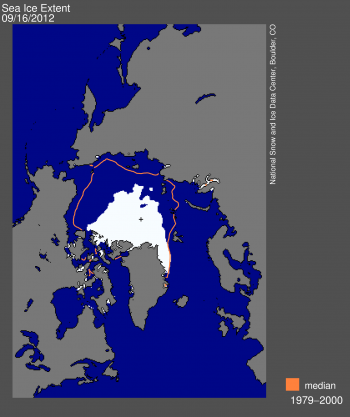
At the end of the 2012 met season sea ice extent had shrunk to just 3.41 million square kilometers according the US National Snow and Ice Data Center (NSIDC), 18% lower than the previous record in 2007 and 49% lower than the long term average. And unlike 2007, 2012 didn't have close to ideal weather conditions for melting ice either. The figure from NSIDC below shows the area of ice extent at the 2012 minimum (white) compared to the long term average (red line)
So why, with worse weather for melting did 2012 break all melting records? The answer probably lies in the volume of ice left. The volume of arctic ice basically relates to it's thickness, with thicker ice less likely melt in the summer. Since the late 70's, arctic sea ice has lost roughly 3/4 of it's volume, including big losses since the last extent (area of sea covered by 15% ice) record in 2007.You can see this progression on the animated chart below thanks to Tamino. Put simply the ice today is thin and weak and it doesn't take much to melt it.
So where to from here. Well, the bad news is that melting arctic ice causes a positive feedback loop. Ice reflects almost all incoming sunlight back in space, while open water absorbs almost all the sun's energy. So, when more ice melts, there is more open water to absorb the sun's rays, heating up the water and melting more ice. This means that the amount of ice is going to keep decreasing, (especially with continuing increases in arctic temperature due to global warming) with a number of predictions that the arctic might be seasonally ice free within a decade or so. Ice will continue to refreeze in winter, but it will be thin and weak and since there isn't much sun in the arctic that time of year it won't make that much difference to the amount of sunlight reflected whether it is there or not.
The arctic meanwhile is going to become a very different place. The loss of sea ice will accelerate arctic warming and completely disrupt the habitat of many of the species that live on or under the ice. Warming is also changing the arctic land environment as well. More importantly for those of us who don't live there, the arctic also plays an important role in northern hemisphere weather and some scientists have pointed the finger at changes in the arctic for extreme weather events in Europe and North America. For example: allowing cold arctic air to "break out" of the arctic and head south to chill the aforementioned regions. You can also find more about this on Skeptical Science.
Lastly, the massive loss of ice in the arctic demonstrates us just how fast things can change. No-one expected the unprecedented ice loss in 2007 and indeed IPCC model forecasts made before the 2007 melt season were not predicting the loss of summer sea ice until near the end of the century. Yet here we are with the possibility it will be gone by the end of the decade. This should remind us conducting an uncontrolled experiment on the earth's climate is going to have surprises, (and probably not many good ones) and that ecosystems can be much more vulnerable to destruction than we realized. It's too late to stop what's happening in the arctic, that would have required taking proper action of global warming decades ago, and only by taking action to halt global warming can we prevent the kind of breakdown occurring in the arctic from happening elsewhere, such as to the great barrier reef.
The arctic is one of the fastest warming places on earth and is already undergoing large changes due to global warming. One of the most obvious examples of this is the arctic sea ice. This is the frozen covering of ice that sits on top of the arctic sea, stretching from Greenland over the north pole to the top of Russia and around past Alaska and the Candian arctic. Every spring and summer the 24 hr sunlight and warmer temperatures melt the ice back northward and before it refreezes again in autumn and winter.
At the end of the 2012 met season sea ice extent had shrunk to just 3.41 million square kilometers according the US National Snow and Ice Data Center (NSIDC), 18% lower than the previous record in 2007 and 49% lower than the long term average. And unlike 2007, 2012 didn't have close to ideal weather conditions for melting ice either. The figure from NSIDC below shows the area of ice extent at the 2012 minimum (white) compared to the long term average (red line)
So why, with worse weather for melting did 2012 break all melting records? The answer probably lies in the volume of ice left. The volume of arctic ice basically relates to it's thickness, with thicker ice less likely melt in the summer. Since the late 70's, arctic sea ice has lost roughly 3/4 of it's volume, including big losses since the last extent (area of sea covered by 15% ice) record in 2007.You can see this progression on the animated chart below thanks to Tamino. Put simply the ice today is thin and weak and it doesn't take much to melt it.
So where to from here. Well, the bad news is that melting arctic ice causes a positive feedback loop. Ice reflects almost all incoming sunlight back in space, while open water absorbs almost all the sun's energy. So, when more ice melts, there is more open water to absorb the sun's rays, heating up the water and melting more ice. This means that the amount of ice is going to keep decreasing, (especially with continuing increases in arctic temperature due to global warming) with a number of predictions that the arctic might be seasonally ice free within a decade or so. Ice will continue to refreeze in winter, but it will be thin and weak and since there isn't much sun in the arctic that time of year it won't make that much difference to the amount of sunlight reflected whether it is there or not.
The arctic meanwhile is going to become a very different place. The loss of sea ice will accelerate arctic warming and completely disrupt the habitat of many of the species that live on or under the ice. Warming is also changing the arctic land environment as well. More importantly for those of us who don't live there, the arctic also plays an important role in northern hemisphere weather and some scientists have pointed the finger at changes in the arctic for extreme weather events in Europe and North America. For example: allowing cold arctic air to "break out" of the arctic and head south to chill the aforementioned regions. You can also find more about this on Skeptical Science.
Lastly, the massive loss of ice in the arctic demonstrates us just how fast things can change. No-one expected the unprecedented ice loss in 2007 and indeed IPCC model forecasts made before the 2007 melt season were not predicting the loss of summer sea ice until near the end of the century. Yet here we are with the possibility it will be gone by the end of the decade. This should remind us conducting an uncontrolled experiment on the earth's climate is going to have surprises, (and probably not many good ones) and that ecosystems can be much more vulnerable to destruction than we realized. It's too late to stop what's happening in the arctic, that would have required taking proper action of global warming decades ago, and only by taking action to halt global warming can we prevent the kind of breakdown occurring in the arctic from happening elsewhere, such as to the great barrier reef.
Monday, September 10, 2012
Yes Virginia, wind power really does decrease carbon emissions
In most technical or scientific fields, the response to self-proclaimed experts who are claiming everyone else has got it wrong should be cautious skepticism. Doubly so when they have little or no actual expertise in the field. Double again when this technical area is anything to do with climate change, which seems to attract self-styled "expert skeptics" like moths to a flame. Unless of course, you are a certain newspaper, then these sorts of claims need to be taken very seriously indeed and given lots of space, even if, for example they contain obviously nonsense, like claiming a huge drop in global temperatures that never actually happened.
Luckily we have journalists at The Climate Spectator and Renew Economy prepared to do a bit of fact checking. And from the latest stoush about wind power two things seem fairly clear.
1. Wind power does decrease the overall carbon footprint of electricity.
2. The growth of renewables (of which wind is a big part) and gas electricity generation, have coincided with a fall in coal power production as the squeeze is put on the most marginal coal plants. According to one energy analyst the combined effect of this and falling demand has been to reduce carbon emission from electricity generation to their lowest levels since 2003.
Luckily we have journalists at The Climate Spectator and Renew Economy prepared to do a bit of fact checking. And from the latest stoush about wind power two things seem fairly clear.
1. Wind power does decrease the overall carbon footprint of electricity.
2. The growth of renewables (of which wind is a big part) and gas electricity generation, have coincided with a fall in coal power production as the squeeze is put on the most marginal coal plants. According to one energy analyst the combined effect of this and falling demand has been to reduce carbon emission from electricity generation to their lowest levels since 2003.
Thursday, May 17, 2012
Australasian warming since 1950 unmatched over last 1000 years
As widely reported in the media, Australian scientists have for the first time created a detailed 1000 year reconstruction of temperatures in Australasia. Although there were no man made thermometers over most of this time, nature contains a number of natural thermometers (like tree rings, corals and ice cores) that scientists can read to piece together many details of temperature and climate in the past. By combining records from a number of different sites scientists have created a temperature record stretching back to AD 1000.
Three main conclusions can be drawn from this paper:
The figure below show's their temperature reconstruction (click on it to embiggen):
Figure 4: Reconstruction of australasian temperatures since 1000 AD compared to 1961-1990 average from thermometers. Black line is 30 year average temperature. Green line is thermometer temperature record for Australasia. Thick black line shows periods with most reliable measurements, thin black line shows when temperature measurements are not so reliable. Shading above and below average line shows the uncertainty of the measurement (this represents the fact that the true average temperature may not be exactly what was reconstructed and shown in the black line, however there will be a very high likelihood the true temperature was within the shaded region).
Both the temperature increase and temperatures in recent times are not matched elsewhere on the graph. Note that although the top of the shaded uncertainty plots do rise above the 1961-1900 average temperature on several occasions the evidence does not support them being warmer. Whereas in recent times the average reconstructed temperature including uncertainty has risen above the 1961-1900 average temperature.
From Gergis et al, 2012. Copyright 2012 American Meteorological Society
Abstract of scientific article can be read here, unfortunately the full paper is behind the journals paywall.
Reference:
Gergis, J., R. Neukom, S. Phipps, A. Gallant, and D. Karoly, 2012: Evidence of unusual late 20th century warming from an Australasian temperature reconstruction spanning the last millennium. J. Climate. doi:10.1175/JCLI-D-11-00649.1, in press.
Three main conclusions can be drawn from this paper:
- The warmth of the climate in Australasia post-1950 is not equaled or surpassed by any time period in the last 1000 years.
- The hottest 30 year period was 1970-2000. (Nb1: the record did not carry on past 2000, Nb2: 30 years is a standard length of time used to look at "climate" as opposed to short term temperature fluctuations)
- "The unusual 20th century warming cannot be explained by natural variability alone, suggesting a strong influence of anthropogenic forcing (human caused warming) in the Australasian region"
The figure below show's their temperature reconstruction (click on it to embiggen):
Figure 4: Reconstruction of australasian temperatures since 1000 AD compared to 1961-1990 average from thermometers. Black line is 30 year average temperature. Green line is thermometer temperature record for Australasia. Thick black line shows periods with most reliable measurements, thin black line shows when temperature measurements are not so reliable. Shading above and below average line shows the uncertainty of the measurement (this represents the fact that the true average temperature may not be exactly what was reconstructed and shown in the black line, however there will be a very high likelihood the true temperature was within the shaded region).
Both the temperature increase and temperatures in recent times are not matched elsewhere on the graph. Note that although the top of the shaded uncertainty plots do rise above the 1961-1900 average temperature on several occasions the evidence does not support them being warmer. Whereas in recent times the average reconstructed temperature including uncertainty has risen above the 1961-1900 average temperature.
From Gergis et al, 2012. Copyright 2012 American Meteorological Society
Abstract of scientific article can be read here, unfortunately the full paper is behind the journals paywall.
Reference:
Gergis, J., R. Neukom, S. Phipps, A. Gallant, and D. Karoly, 2012: Evidence of unusual late 20th century warming from an Australasian temperature reconstruction spanning the last millennium. J. Climate. doi:10.1175/JCLI-D-11-00649.1, in press.
Sunday, November 20, 2011
International Energy Agency: the door to 2°C is closing
These are the words from the 2011 World Energy Outlook recently released by the International Energy Agency (IEA). Although a conservative organization the IEA take climate change very seriously and included in their report detailed investigations of potential energy senario's and how they will affect climate change.
Here's their most salient conclusions (emphasis mine)
For a more detail discussion see Skeptical Science, basically the IEA looked at 3 future scenario's:
Business as usual = 6°C warming
New Policies (governments meet all pledges made to date) = 3.5°C warming
450ppm (requires much greater action) = 50% chance of limiting warming to 2°C.
2°C warming is seen at the red line we don't want to cross, therefore it is clear much more world action is required.
Time is of the essence to take action to meet a 450 ppm target because existing polluting infrastructure (power plants, factories etc) is almost at the level that uses up all our "carbon budget". The implication of this is that unless action is taken now then worldwide by 2017 any new infrastructure will need to replace those already existing or be zero carbon, or we blow the budget. This is why some news stories have reported we have "5 years" to act on climate change before it is too late.
This is also why those who claim they support climate action, just not now, are misguided. Such a "strategy" is not only far more expensive in the long run, but runs the risk of beginning too late because the "locked in" polluting infrastructure is already great enough to cause dangerous climate change. The fact is a coal plant will operate/ pollute for 50 years, while new but inefficient buildings built today could be around for even longer.
The good news (from Australia's point of view) is that with the passage of the carbon price, we'll be getting started on action. One of the early effects (and perhaps one that is already being felt) will be that new power generation in Australia probably won't include coal plants and that more efficient buildings, factories and appliances will become the norm.
I'll leave the last word to the IEA:
Here's their most salient conclusions (emphasis mine)
We cannot afford to delay further action to tackle climate change if the long-term target of limiting the global average temperature increase to 2°C, as analysed in the 450 Scenario, is to be achieved at reasonable cost. In the New Policies Scenario, the world is on a trajectory that results in a level of emissions consistent with a long-term average temperature increase of more than 3.5°C. Without these new policies, we are on an even more dangerous track, for a temperature increase of 6°C or more.
Four-fifths of the total energy-related CO2 emissions permissible by 2035 in the 450 Scenario are already “locked-in” by our existing capital stock (power plants, buildings, factories, etc.). If stringent new action is not forthcoming by 2017, the energy-related infrastructure then in place will generate all the CO2 emissions allowed in the 450 Scenario up to 2035, leaving no room for additional power plants, factories and other infrastructure unless they are zero-carbon, which would be extremely costly. Delaying action is a false economy: for every $1 of investment avoided in the power sector before 2020 an additional $4.3 would need to be spent after 2020 to compensate for the increased emissions.
For a more detail discussion see Skeptical Science, basically the IEA looked at 3 future scenario's:
Business as usual = 6°C warming
New Policies (governments meet all pledges made to date) = 3.5°C warming
450ppm (requires much greater action) = 50% chance of limiting warming to 2°C.
2°C warming is seen at the red line we don't want to cross, therefore it is clear much more world action is required.
Time is of the essence to take action to meet a 450 ppm target because existing polluting infrastructure (power plants, factories etc) is almost at the level that uses up all our "carbon budget". The implication of this is that unless action is taken now then worldwide by 2017 any new infrastructure will need to replace those already existing or be zero carbon, or we blow the budget. This is why some news stories have reported we have "5 years" to act on climate change before it is too late.
This is also why those who claim they support climate action, just not now, are misguided. Such a "strategy" is not only far more expensive in the long run, but runs the risk of beginning too late because the "locked in" polluting infrastructure is already great enough to cause dangerous climate change. The fact is a coal plant will operate/ pollute for 50 years, while new but inefficient buildings built today could be around for even longer.
The good news (from Australia's point of view) is that with the passage of the carbon price, we'll be getting started on action. One of the early effects (and perhaps one that is already being felt) will be that new power generation in Australia probably won't include coal plants and that more efficient buildings, factories and appliances will become the norm.
I'll leave the last word to the IEA:
“If we don’t change direction soon, we’ll end up where we’re heading”
Wednesday, October 12, 2011
TTKD October meeting: Carbon Nation Film Screening
At the Transition Town Kenmore October meeting will be showing Carbon Nation, a film that is ideal for people who are new to the area of climate action.
Carbon Nation is a climate change solutions movie that doesn’t even care if you believe in climate change! Join us for Carbon Nation (84 mins) followed by a short film about Australia’s Beyond Zero Emissions Zero Carbon Australia Project.
Watch the trailer here www.carbonnationmovie.com
Cliff Etheredge, West Texas Wind Farmer Photo Credit: Peter Byck
About the Film: Tired of the doom-and-gloom news about climate change? Carbon Nation is an inspirational, upbeat, non-preachy, non-partisan film that illustrates how solutions to climate change make great business sense, among other things. You’ll meet a host of entertaining and endearing characters along the way.
Thursday October 20, 7.30pm
Kenmore Library Meeting Room
Tuesday, September 27, 2011
Powershift 2011
The Australian Youth Climate Coalition (AYCC) are running their annual Power Shift next month and this year it is in Brisbane. Tickets are still available and it'll no doubt be an awesome weekend for all involved. Here's the details:
"Power Shift 2011 is coming to Brisbane on Saturday 15 - Monday 17 October. If you are aged between 15-29 or know someone in this age range who may be interested... Start the transformation.
Climate change is the challenge and opportunity of our generation – it’s not about politics, its about ensuring a safe future for young people across Australia. Power Shift 2011 will be the moment when our generation comes together, and starts the transformation we need to become a nation powered by renewable energy.
In September and October, thousands of young people will come together for two incredible summits in Perth and Brisbane. Together we’ll engage with the solutions, make our voice heard, and launch a campaign to transform the country."
For more info, check out http://www.powershift.org.au/
Tuesday, August 9, 2011
Room for optomism - climate action in China
The rising emissions of carbon dioxide in China is one of the favourite excuses of those who would rather not act on climate change for not doing so. However, a look at what is actually happening in China and their future plans makes it clear they are taking climate change very seriously.
Obviously compared to Australia, China is in a different position with a rapidly developing economy and rising standards of living pushing hundreds of millions of people out of poverty and into the middle class.
Announcements in the last week or so have shown that China plans to:
- Introduce a feed-in tariff for solar power, which is likely to spur massive growth in solar PV generation.
- Set a cap on total energy use, which will help them in their plans to:
1) Improve energy efficiency
2) Set up a number of regional greenhouse gas emissions trading schemes.
3) Track of progress of indiviual provinces towards their emissions goals
4) Integrate regulatory policies such a greener building codes into a national policy.
China's overall goal is to decrease the "carbon intensity" of their economy by 40-45% by 2020. By carbon intensity they mean that a unit of economic active will produce ~40% less carbon emissions that it previously did. Even with these improvements China's emissions are going to continue to rise for the time being (however without serious action so will ours in Australia). What these actions aim to do is slow the emissions increases in China and stabilise them as quickly as possible, at which point they will likely still be considerably lower per person than here in Oz.
These actions in China, while helping them to continue to dominate the clean energy race, will also help to put them on a path to stabilising their carbon emissions. However, nothing promotes progress like progress and we in Australia, as one of the worlds top 20 largest economies and top 20 largest C02 emitters, have a responsibility to play our part by cutting our own emissions and then pushing China to do even more.
Obviously compared to Australia, China is in a different position with a rapidly developing economy and rising standards of living pushing hundreds of millions of people out of poverty and into the middle class.
Announcements in the last week or so have shown that China plans to:
- Introduce a feed-in tariff for solar power, which is likely to spur massive growth in solar PV generation.
- Set a cap on total energy use, which will help them in their plans to:
1) Improve energy efficiency
2) Set up a number of regional greenhouse gas emissions trading schemes.
3) Track of progress of indiviual provinces towards their emissions goals
4) Integrate regulatory policies such a greener building codes into a national policy.
China's overall goal is to decrease the "carbon intensity" of their economy by 40-45% by 2020. By carbon intensity they mean that a unit of economic active will produce ~40% less carbon emissions that it previously did. Even with these improvements China's emissions are going to continue to rise for the time being (however without serious action so will ours in Australia). What these actions aim to do is slow the emissions increases in China and stabilise them as quickly as possible, at which point they will likely still be considerably lower per person than here in Oz.
These actions in China, while helping them to continue to dominate the clean energy race, will also help to put them on a path to stabilising their carbon emissions. However, nothing promotes progress like progress and we in Australia, as one of the worlds top 20 largest economies and top 20 largest C02 emitters, have a responsibility to play our part by cutting our own emissions and then pushing China to do even more.
Wednesday, August 3, 2011
The government's carbon price mailout
I've just finished reading the Gillard governments' carbon price mailout which arrived yesterday.
It reinforces in my mind, how, by creating a comprehensive policy, they have also created quite a complex policy. Although the household compensation is only one aspect of the package it takes up the vast majority of the handout. (For anyone reading who wants to know how you and your family will be affected the best way to check is this online calculator). As far as I can tell everything in the mailout is more or less correct and I thought the section "How will a carbon price cut pollution?" was quite good with some pertinent points:
The mailout does spend a bit of time talking about one aspect of the package that I like, which is the increase in the tax free threshold from $6000/year to over $18 000/year. I have seen some commentators criticize the package for including things like this, saying it makes it too complex and distracts from the main message. On the other hand, since the package needed to include household compensation anyway, why not utilise the chance to introduce a tax change recommended by the Henry review and which the economic boffins think is a good idea.
Conversely the mailout spends very little time talking about the $10 billion dollars for clean energy in the carbon package. $10 billion dollars is a serious chunk of change and should be a big shot in the arm to the industry. Hopefully this policy has got into the general consciousness of the public despite all the other parts of the package competing for airtime.
Lastly, it is always going to be somewhat controversial when a government carries out public education campaigns. I can understand why some would rather the government not spend any taxpayer money on such things. On the other hand, this is a large and complex policy with important implications for the country. A loud, well funded and often misleading campaign has and is being run against it. In such a case do people not deserve to be given the facts lest they form their opinions based on incorrect or misleading information? In this the mailout does ok but isn't perfect, while it is clear from reading it that not everyone is fully compensated, perhaps unsurprising there are no profiles on a family from the minority of Australian's (generally the wealthy) who won't be fully compensated. Guess that's PR for you.
It reinforces in my mind, how, by creating a comprehensive policy, they have also created quite a complex policy. Although the household compensation is only one aspect of the package it takes up the vast majority of the handout. (For anyone reading who wants to know how you and your family will be affected the best way to check is this online calculator). As far as I can tell everything in the mailout is more or less correct and I thought the section "How will a carbon price cut pollution?" was quite good with some pertinent points:
"Currently, releasing carbon pollution is free despite the fact that it is harming Australia's environmentI think this is quite a good way to explain in a nutshell how and why a carbon price will be effective. It seems the govt has decided to back off talking about how carbon pricing will change consumer behaviour at the household level (although it will to some extent) and focus on where most of the action is, which is investment decisions by large companies, especially the large polluters.
A carbon price changes this. It puts a price on the carbon pollution that Australia's largest polluters produce. This creates a powerful incentive for businesses to cut their pollution, by investing in clean energy or finding more efficient ways of operating"
The mailout does spend a bit of time talking about one aspect of the package that I like, which is the increase in the tax free threshold from $6000/year to over $18 000/year. I have seen some commentators criticize the package for including things like this, saying it makes it too complex and distracts from the main message. On the other hand, since the package needed to include household compensation anyway, why not utilise the chance to introduce a tax change recommended by the Henry review and which the economic boffins think is a good idea.
Conversely the mailout spends very little time talking about the $10 billion dollars for clean energy in the carbon package. $10 billion dollars is a serious chunk of change and should be a big shot in the arm to the industry. Hopefully this policy has got into the general consciousness of the public despite all the other parts of the package competing for airtime.
Lastly, it is always going to be somewhat controversial when a government carries out public education campaigns. I can understand why some would rather the government not spend any taxpayer money on such things. On the other hand, this is a large and complex policy with important implications for the country. A loud, well funded and often misleading campaign has and is being run against it. In such a case do people not deserve to be given the facts lest they form their opinions based on incorrect or misleading information? In this the mailout does ok but isn't perfect, while it is clear from reading it that not everyone is fully compensated, perhaps unsurprising there are no profiles on a family from the minority of Australian's (generally the wealthy) who won't be fully compensated. Guess that's PR for you.
Saturday, July 30, 2011
Unravelling a few of Australia's climate change myths
Australia has recently been host to a fairly prominent visitor from the UK, no not that one, I mean Sir Richard Lambert. Until recently Lambert was Director-General of the Confederation of British Industry, the UK's top business and industry organisation. So it's fair to assume he has a good knowledge of how business is affected by and responds to carbon pricing like they have in Europe.
Lambert has clearly been quite surprised by the nature of the climate change "debate" in Australia and has contributed a post to ABC The Drum "Unravelling a few of Australia's climate change myths". Worth a read. See him also on Lateline business.
Friday, July 15, 2011
10 things to know about the carbon price
We now know the details of the governments package to tackle climate change by pricing carbon pollution. My live blog about the carbon price was a bit messy. So I've cleaned it up a bit.
Here are the 10 important points:
1. A price on pollution of $23 a ton
2. Pollution cuts of at least 5% by 2020 and 80% by 2050
3. Scheme starts as a "tax" but moves to an emissions trading scheme in 2015
4. 500 biggest polluters will pay for their carbon pollution
5. Price rises will be modest - expected to raise average prices by 0.7%
6. Compensation for households will see most better or no worse off
7. Tackling climate change now is cheaper and easier than waiting or doing nothing
8. Over 10 billion dollars for renewable energy
9. Money for storing carbon in land, improving biodiversity, closing down the dirtiest coal plants and helping industry be more efficient.
10. Vulnerable industries who are trade exposed get generous assistance
For more detail on each point see this post.
Here are the 10 important points:
1. A price on pollution of $23 a ton
2. Pollution cuts of at least 5% by 2020 and 80% by 2050
3. Scheme starts as a "tax" but moves to an emissions trading scheme in 2015
4. 500 biggest polluters will pay for their carbon pollution
5. Price rises will be modest - expected to raise average prices by 0.7%
6. Compensation for households will see most better or no worse off
7. Tackling climate change now is cheaper and easier than waiting or doing nothing
8. Over 10 billion dollars for renewable energy
9. Money for storing carbon in land, improving biodiversity, closing down the dirtiest coal plants and helping industry be more efficient.
10. Vulnerable industries who are trade exposed get generous assistance
For more detail on each point see this post.
Saturday, May 21, 2011
Malcolm in the middle
Former Liberal leader Malcolm Turnbull has created a bit of a storm this week after offering a straightforward critique of the Liberal parties' own climate change policy on ABC Lateline (transcript and video here).
Turnbull who has long publicly favored a market based scheme as opposed to the Liberal's "direct action" policy, is probably guilt of making that unforgivable mistake in politics, telling the truth, without any spin.
So what did Malcolm say?
Well, basically, he explained how the "direct action" policy works.
"Direct action" allows polluters to pollute and then the government uses taxpayers money to buy pollution offsets. While this can decrease "net" pollution, it doesn't create a low carbon economy and as business pollution levels continue to rise you need to buy more and more offsets to reduce your overall levels of pollution. In the long term with Oz needing to cut its carbon pollution emissions by 80% or more, these taxpayer funded offsets would become "very expensive".
Some quotes:
Turnbull is also in hot water with the Libs, but lauded by Labour, for saying that the "two virtues" of the Libs direct action policy "from the point of view of Mr Abbott and (shadow environment minister) Mr Hunt" are that a direct action policy is easy to stop if 1) climate change isn't real, or 2) if you decide acting on climate change is too hard. Considering the enormous weight of evidence that humans are causing climate change and it is a serious problem we need to deal with, my impression is that Turnbull is telling us the Libs either don't know the science, and/or don't take climate change policy seriously.
Why is all this important?
Probably because since both major parties are offering climate change policies it is important to view each critically. The Liberal's policy isn't efficient and in order to work could be very expensive on the taxpayer. Even more importantly because there would little/no incentive for polluters to cut their pollution, Australia would fail to move to a low carbon economy, a serious problem is the long run.
Update: Malcolm Turnbull has issued this defense/ explanation of his interview comments on his website. Basically he uses a lot more words to say the same thing and points out that what people took as him been critical was simply him accurately explaining the policy (though I think they are probably one and the same).
Turnbull who has long publicly favored a market based scheme as opposed to the Liberal's "direct action" policy, is probably guilt of making that unforgivable mistake in politics, telling the truth, without any spin.
So what did Malcolm say?
Well, basically, he explained how the "direct action" policy works.
"Direct action" allows polluters to pollute and then the government uses taxpayers money to buy pollution offsets. While this can decrease "net" pollution, it doesn't create a low carbon economy and as business pollution levels continue to rise you need to buy more and more offsets to reduce your overall levels of pollution. In the long term with Oz needing to cut its carbon pollution emissions by 80% or more, these taxpayer funded offsets would become "very expensive".
Some quotes:
"But the way it works is that the taxpayer - the taxpayers' money would be used to buy carbon offsets from farmers, so that as industry pollutes, the Government would then spend taxpayers' dollars to buy carbon offsets to offset that pollution."
"if you want to have a long-term technique of cutting carbon emissions, you know, in a very substantial way to the levels that the scientists are telling us we need to do by mid-century to avoid dangerous climate change, then a direct action policy where the Government - where industry was able to freely pollute, if you like, and the Government was just spending more and more taxpayers' money to offset it, that would become a very expensive charge on the budget in the years ahead."
Turnbull is also in hot water with the Libs, but lauded by Labour, for saying that the "two virtues" of the Libs direct action policy "from the point of view of Mr Abbott and (shadow environment minister) Mr Hunt" are that a direct action policy is easy to stop if 1) climate change isn't real, or 2) if you decide acting on climate change is too hard. Considering the enormous weight of evidence that humans are causing climate change and it is a serious problem we need to deal with, my impression is that Turnbull is telling us the Libs either don't know the science, and/or don't take climate change policy seriously.
Why is all this important?
Probably because since both major parties are offering climate change policies it is important to view each critically. The Liberal's policy isn't efficient and in order to work could be very expensive on the taxpayer. Even more importantly because there would little/no incentive for polluters to cut their pollution, Australia would fail to move to a low carbon economy, a serious problem is the long run.
Update: Malcolm Turnbull has issued this defense/ explanation of his interview comments on his website. Basically he uses a lot more words to say the same thing and points out that what people took as him been critical was simply him accurately explaining the policy (though I think they are probably one and the same).
Wednesday, May 18, 2011
Carbon pricing silly season - The Australian edition
Yesterday I remarked on the rather alarmist headline the SMH ran on the front page. But it seems like The Australian is doing its best to get in on the act with "Summer of disaster 'not climate change': Rajendra Pachauri"
Reading the article though, its clear thats not what Rajendra Pachauri, the head of the IPCC, said.
Again this stuff isn't rocket science, climate change changes the climate. The air and oceans are warmer than they used to be. The atmosphere contains more water vapour. Warmer temperatures mean more heat waves and more moisture in the air provides more fuel for storms.
Or as top climate scientist Dr Kevin Trenberth put it, speaking about the effect of climate change on weather events
So basically climate change has a hand in all the weather nowadays, the "systematic influence", and can act with a La Nina, or an El Nino to create more and greater extreme events than would have happened otherwise. But did climate change "cause" an single event? Well that's very difficult to answer without a lot of study, although studies are now starting to appear showing human caused climate change can make individual extreme weather events more likely to occur.
Reading the article though, its clear thats not what Rajendra Pachauri, the head of the IPCC, said.
Intergovernmental Panel on Climate Change chairman Rajendra Pachauri said the general observation that climate change was bringing about an increase in extreme weather events was valid but scientists needed to provide much finer detail.
...
"What we can say very clearly is the aggregate impact of climate change on all these events, which are taking place at much higher frequency and intensity all over the world.
"On that there is very little doubt; the scientific evidence is very, very strong. But what happens in Queensland or what happens in Russia or for that matter the floods in the Mississippi River right now, whether there is a link between those and climate change is very difficult to establish. So I don't think anyone can make a categorical statement on that."
Again this stuff isn't rocket science, climate change changes the climate. The air and oceans are warmer than they used to be. The atmosphere contains more water vapour. Warmer temperatures mean more heat waves and more moisture in the air provides more fuel for storms.
Or as top climate scientist Dr Kevin Trenberth put it, speaking about the effect of climate change on weather events
"there is a systematic influence on all of these weather events now-a-days because of the fact that there is this extra water vapor lurking around in the atmosphere than there used to be say 30 years ago"
So basically climate change has a hand in all the weather nowadays, the "systematic influence", and can act with a La Nina, or an El Nino to create more and greater extreme events than would have happened otherwise. But did climate change "cause" an single event? Well that's very difficult to answer without a lot of study, although studies are now starting to appear showing human caused climate change can make individual extreme weather events more likely to occur.
Sunday, April 10, 2011
The Brisbane climate action rally
Thanks to everyone who came to the Brisbane Climate Action Rally yesterday. There was a great turnout and a really positive atmosphere of people who want Australia to cut pollution and start moving to a clean energy economy.
There were some cool placards too, thanks to John Cook from Skeptical Science for capturing some of them.
Subscribe to:
Posts (Atom)