As you go into vote this weekend you may want to consider how the various parties rate on issues important to Transition Town Kenmore (TTKD) such as action on climate change and increasing resilience in the face of resource depletion (a good example of this would be policies on active and public transport). While TTKD does not endorse any particular political party I've written a bit of a guide to the policies of the major parties.
With regards to climate change both the Climate Institute (CI) and the Australian Conservation Foundation (ACF) have climate policy scorecards, which are very quick to look at.
See the CI pollute-o-meter here.
See the ACF environmental scorecard here.
Summary of policies on Climate and Public Transport
Price on Carbon:
Both Labour and the Green support price on carbon pollution where major polluters pay for each ton of carbon they emit. Total emissions of pollution are capped and decrease each year. Most people are compensated for price rises that occur as a result of polluting companies paying a carbon price. Such market based mechanisms are generally agreed to be the cheapest and most effective means of cutting pollution. The Green aim for a much more ambitious cut to Australia's carbon emissions.
The Coalition plan to scrap the polluter pays carbon pricing scheme and instead use general taxpayer revenue to pay major polluters to "decrease" the amount of pollution they emit. I say "decrease" because it is not totally clear to me if a polluter actually has to decrease their emissions. It may well be fine for a polluter to accept money to increase their emission, but by a smaller amount than they originally expected too. Credible estimates suggest by 2020 Australia's emissions will increase under this scheme. This is for 2 reasons. Firstly not a lot of money (in the scheme of thing) is available for grants to polluters and secondly because while some polluters will decrease their emissions using the grants, other companies not involved in the scheme will increase their emissions.
The Coalition also plan to fund a "green army" to plant trees and look after local environments. This is unlikely to have an significant impact on Australia's carbon emmissions but may help in local re-vegetation and improve health of creek catchments etc.
Climate Change Authority:
Labour and the Greens plan to keep the Climate Change Authority (CCA), an independent body set up to advise the government on addressing climate change. The Coalition plans to scrap the CCA.
Clean Energy Finance Corporation:
Labour and the Green plan to keep the Clean Energy Finance Corporation, which has $10 billion dollars to invest in clean energy and energy efficiency (ie: helping fund wind and solar farms, helping businesses to decrease their energy costs). The Coalition plans to scrap the Clean Energy Finance Corporation.
2020 renewable energy target:
All major parties support the renewable energy target. However The Coalition plan to review the target in 2014.
Public transport:
The Greens will probably support any worthwhile public transport scheme and also support an eventual Brisbane to Melbourne (via Sydney and Canberra) high speed rail line.
Labour support new rail lines in Brisbane (ie: cross river rail), Melbourne and elsewhere, generally through these project being recommended by Infrastructure Australia as projects of national significance.
The Coalition will stop all federal funding for commuter rail. Locally this means Cross River Rail will not go ahead as it is very unlikely the State Government can afford the cost on its own. Without cross river rail much of the rail network will hit capacity in 2016 and not be able to take extra passengers at peak times.
Showing posts with label carbon price. Show all posts
Showing posts with label carbon price. Show all posts
Thursday, September 5, 2013


Thursday, July 11, 2013
Is the carbon price reducing emissions?
Good article at The Conversation looking at the carbon price one year on. We know that in the last year electricity demand and emissions have fallen, but how much of this is due to the carbon price, the renewable energy target (RET) or other one off events?
As I have mentioned here a few times here and is explained in the article, the main impact of carbon pricing is to change long term investments decisions. Once built power plants are around for a long time, so once a coal plant is built you essentially lock in it's emissions for the next 30-50 years. Carbon pricing (along with the RET) are changing investment decisions and so planned new power plants in Australia are now dominated by gas and wind not coal. That this is already occurring as can be seen by the list of electricity projects underway or planned as of late last year. (Since then, it is worth noting, one of the two coal projects underway has been scrapped). This data also shows how over the last few years a much greater percentage of power plants being built are renewables.
So while it is hard to say exactly how much of the emissions reductions in the electricity sector in the past year are due to the carbon price, it already seems clear that over the long term it is driving us towards a low carbon future.
As I have mentioned here a few times here and is explained in the article, the main impact of carbon pricing is to change long term investments decisions. Once built power plants are around for a long time, so once a coal plant is built you essentially lock in it's emissions for the next 30-50 years. Carbon pricing (along with the RET) are changing investment decisions and so planned new power plants in Australia are now dominated by gas and wind not coal. That this is already occurring as can be seen by the list of electricity projects underway or planned as of late last year. (Since then, it is worth noting, one of the two coal projects underway has been scrapped). This data also shows how over the last few years a much greater percentage of power plants being built are renewables.
So while it is hard to say exactly how much of the emissions reductions in the electricity sector in the past year are due to the carbon price, it already seems clear that over the long term it is driving us towards a low carbon future.
Saturday, June 29, 2013
Clean Energy Finance Corp inks first deal - $100 million for business in renewables and energy efficiency
The Clean Energy Finance Corporation (CEFC), set up as part of the Clean Energy Future/Carbon Price law, has just signed it's first deal to supply up to $100 million dollars in loans to businesses looking to improve their energy efficiency, buy solar panels or set up cogeneration and trigeneration plants.
The CEFC, which will have $10 billion dollars to invest over the next 5 years, was set up to help fund renewable energy, low emission technologies and energy efficiency investments. The general idea is the fund will partner with the private sector and chip in some of the money for these investments, for example this new deal includes $50 million from both the CEFC and $50 million from the Commonwealth bank. In this way the CEFC can use it's $10 billion to stimulate much greater amounts of investment in clean energy and energy efficiency. Operating at arms reach from the government, the CEFC also aims to make it's money back in the long term.
Unfortunately, the Coalition has vowed to scrap the CEFC if it wins the election, which would be a shame because the CEFC plays an essential role in promoting renewable energy. Currently it can be difficult for renewable energy plants to attract financing and get built, this is especially so where the technology is new and/or the first of a kind in Australia. This so called "valley of death" makes it extremely difficult for renewable technologies to get started and start to power Australia. By making at least part of the financing required available, the CEFC makes such projects more attractive to the private sector and spurs investment in renewable. Scrap the CEFC and it will likely be much harder and more expensive for Australia to meet it's targets for generating renewable electricity and lowering greenhouse gas emissions, as well as for companies to bring new and innovative technologies to the market.
The CEFC, which will have $10 billion dollars to invest over the next 5 years, was set up to help fund renewable energy, low emission technologies and energy efficiency investments. The general idea is the fund will partner with the private sector and chip in some of the money for these investments, for example this new deal includes $50 million from both the CEFC and $50 million from the Commonwealth bank. In this way the CEFC can use it's $10 billion to stimulate much greater amounts of investment in clean energy and energy efficiency. Operating at arms reach from the government, the CEFC also aims to make it's money back in the long term.
Unfortunately, the Coalition has vowed to scrap the CEFC if it wins the election, which would be a shame because the CEFC plays an essential role in promoting renewable energy. Currently it can be difficult for renewable energy plants to attract financing and get built, this is especially so where the technology is new and/or the first of a kind in Australia. This so called "valley of death" makes it extremely difficult for renewable technologies to get started and start to power Australia. By making at least part of the financing required available, the CEFC makes such projects more attractive to the private sector and spurs investment in renewable. Scrap the CEFC and it will likely be much harder and more expensive for Australia to meet it's targets for generating renewable electricity and lowering greenhouse gas emissions, as well as for companies to bring new and innovative technologies to the market.
Sunday, June 16, 2013
Queensland electricity prices to soar by 22%, who's to blame?
Many of you will have heard that electricity prices in QLD are skyrocketing by 22% this year. For the average household this is predicted to increase bills by $268 a year, while "the average electricity bill for a family of four will increase by $343 a year".
If you listen to Campbell Newman or the energy minister Mark McArdle you might be forgiven for thinking that this increase was due to carbon pricing or renewable energy. With McArdle complaining that "Ninety-two thousand homes don't pay any power bills at all in Queensland" - well yes Mark, that's because they produce their own electricity.
However with the help of this article and Queensland Competition Authority price determination I've made this little graph of where the price rises are coming from:

As you can see, less than 20% of price rises are due to carbon pricing or paying people for the solar power they produce. Much greater is the price rise due to the end of the Newman government's electricity tarrif freeze, which only lasted for 12 months. This policy might have sounded great during the last state election, but there's no free lunches in this world, and we are paying for it now.
"Other*" is the biggest category, breaking this down is hard, but it includes increased network prices (ie: the poles and wires), increases in the costs of generating power and then some mind-blowing stuff like electricity companies being allowed to increase prices because power demand has been dropping and they have been making less money than they want to.
So it seems that the government is very concerned about the 20% of the price rises due to polluters no longer being able to pollute for free and for actually having to pay households who are producing clean energy from their solar panels. Instead they seem rather unconcerned (or want to shift our attention from) what is actually causing 80% of the price rises. This is like the captain of the titanic blaming the water on drinks that were spilled when the ship hit the iceberg rather than the gaping hole in the ship.
From all this I draw two conclusions:
1. All that kerfuffle from certain politicians that the (basically one off) 9% rise in power prices from the carbon price was going to ruin us all was self serving nonsense. A year later we are facing over double that rise for different reasons and the idea this will ruin us all has been conveniently forgotten.
2. We as a community are going to have to start demanding explanations for what's causing 80% of our power prices rises and then demand useful ideas for what to do about it, or we'll continue to see politicians scapegoating renewable energy and a continuation of massive price rises.
If you listen to Campbell Newman or the energy minister Mark McArdle you might be forgiven for thinking that this increase was due to carbon pricing or renewable energy. With McArdle complaining that "Ninety-two thousand homes don't pay any power bills at all in Queensland" - well yes Mark, that's because they produce their own electricity.
However with the help of this article and Queensland Competition Authority price determination I've made this little graph of where the price rises are coming from:
As you can see, less than 20% of price rises are due to carbon pricing or paying people for the solar power they produce. Much greater is the price rise due to the end of the Newman government's electricity tarrif freeze, which only lasted for 12 months. This policy might have sounded great during the last state election, but there's no free lunches in this world, and we are paying for it now.
"Other*" is the biggest category, breaking this down is hard, but it includes increased network prices (ie: the poles and wires), increases in the costs of generating power and then some mind-blowing stuff like electricity companies being allowed to increase prices because power demand has been dropping and they have been making less money than they want to.
So it seems that the government is very concerned about the 20% of the price rises due to polluters no longer being able to pollute for free and for actually having to pay households who are producing clean energy from their solar panels. Instead they seem rather unconcerned (or want to shift our attention from) what is actually causing 80% of the price rises. This is like the captain of the titanic blaming the water on drinks that were spilled when the ship hit the iceberg rather than the gaping hole in the ship.
From all this I draw two conclusions:
1. All that kerfuffle from certain politicians that the (basically one off) 9% rise in power prices from the carbon price was going to ruin us all was self serving nonsense. A year later we are facing over double that rise for different reasons and the idea this will ruin us all has been conveniently forgotten.
2. We as a community are going to have to start demanding explanations for what's causing 80% of our power prices rises and then demand useful ideas for what to do about it, or we'll continue to see politicians scapegoating renewable energy and a continuation of massive price rises.
Thursday, January 31, 2013
California lauches Cap and Trade scheme
A quick update from overseas. The US state of California introduced it's carbon price on the first of January. California is using a cap and trade system (also known as an emissions trading scheme /ETS).
This action by California is important for a couple of reasons. Firstly, California is the most populous state in USA and it has a very large economy. In fact, if California was a country, it would be one of the ten largest economies in the world. Secondly, California has for a long time lead environmental action in the USA, so a successful emissions trading scheme there will help to push others states and perhaps the US federal government to take more action.
The Californian scheme is cap and trade. This is where the government caps the amount of carbon pollution that can be released into the atmosphere for each year and then large polluters have to buy permits to cover all the carbon they have released. This provides a financial incentive to reduce emissions and also makes renewable energy and "low carbon" goods and services more competitive.
In cap and trade, the cap is lowered over time, so less and less pollution can be emitted. Companies that need permits can buy them from companies that have reduced their emissions and so don't require them, providing a second way for business to profit from cleaning up their act.
How does this compare to the Australian carbon price? In its current (and introductory) form, Australia has a fixed price for pollution permits but the number of permits is not capped. This will change in 2015 when the scheme switches to emissions trading, very similar to what has now launched on California.
It is worth noting that in California many (but not all) of the permits are currently being given away to help business adjust to the scheme, although this will decrease as time goes on. It is worth noting that even when permits are given away there is still an incentive to reduce emissions because then you can sell your permits and make a profit. A similar process is occurring in Australia where trade exposed industries receive many of the permits (up to 95%) for free, although again this will decrease over time.
This action by California is important for a couple of reasons. Firstly, California is the most populous state in USA and it has a very large economy. In fact, if California was a country, it would be one of the ten largest economies in the world. Secondly, California has for a long time lead environmental action in the USA, so a successful emissions trading scheme there will help to push others states and perhaps the US federal government to take more action.
The Californian scheme is cap and trade. This is where the government caps the amount of carbon pollution that can be released into the atmosphere for each year and then large polluters have to buy permits to cover all the carbon they have released. This provides a financial incentive to reduce emissions and also makes renewable energy and "low carbon" goods and services more competitive.
In cap and trade, the cap is lowered over time, so less and less pollution can be emitted. Companies that need permits can buy them from companies that have reduced their emissions and so don't require them, providing a second way for business to profit from cleaning up their act.
How does this compare to the Australian carbon price? In its current (and introductory) form, Australia has a fixed price for pollution permits but the number of permits is not capped. This will change in 2015 when the scheme switches to emissions trading, very similar to what has now launched on California.
It is worth noting that in California many (but not all) of the permits are currently being given away to help business adjust to the scheme, although this will decrease as time goes on. It is worth noting that even when permits are given away there is still an incentive to reduce emissions because then you can sell your permits and make a profit. A similar process is occurring in Australia where trade exposed industries receive many of the permits (up to 95%) for free, although again this will decrease over time.
Tuesday, January 1, 2013
Clean energy 2012: year in review
Now that 2013 has begun, here's a look back at the top ten clean energy stories from 2012, thanks to Renew Economy.
Stories include:
1. Australia introduces a carbon price, the world doesn’t come to an end
2. The opening of Australia’s first utility-scale solar PV farm
3. Australia passes 2,000MW mark on household rooftops
4. South Australia’s wind success story
5. Germany’s solar success story.
Read about these and n.o.s 6-10 here.
Happy new year everyone.
Stories include:
1. Australia introduces a carbon price, the world doesn’t come to an end
2. The opening of Australia’s first utility-scale solar PV farm
3. Australia passes 2,000MW mark on household rooftops
4. South Australia’s wind success story
5. Germany’s solar success story.
Read about these and n.o.s 6-10 here.
Happy new year everyone.
Sunday, December 23, 2012
Emissions sink as consumers turn off coal
Interesting article in the fairfax papers a couple of days ago about how falling demand for electricity across the eastern seaboard is causing a drop in electricity generated from coal.
We have mentioned the squeeze that is being put on a lot of coal plants previously. The electricity sector is complex but several things seem to be happening at the moment.
1. Demand for (and use of) electricity is dropping and has been for several years. This is likely a response to higher prices causing people and businesses to use less electricity and, at the residential level, has been helped by the widespread uptake of solar panels and solar hotwater. This fall in demand then squeezes out the least competitive generators, which are often coal plants.
2. As the amount of renewable energy available increases but demand does not then the generators who can sell their power for the least cost have an advantage. The renewable energy target means that much of this renewable energy must be used and because their electricity costs so little to generate many renewable energy generators can undercut fossil fuel plant prices anyway. This phenomenon, known as the merit order effect, again squeezes the least competitive generators, often coal plants.
3. The carbon price, which makes makes more polluting electricity more expensive to generate then amplifies points 1&2, making the dirtiest generators even less competitive.
The net effect of all this: C02 emissions from the electricity sector are falling, which is a very good thing.
Update: Giles Parkinson at Renew Economy wrote about this as well, and his article also contains graphs showing the change in the generation mix and energy use in each state.
"Weak demand for electricity across eastern mainland states has sparked a “dramatic fall” in greenhouse gas emissions from Australia's power stations, the latest review of data by consultants Pitt & Sherry has found.
While demand for base-load electricity from black coal-fired power stations has been in retreat for about three years, the decline has extended in recent months to two of Victoria's emissions-intensive brown coal-fired plants, Hazelwood and Yallourn"You can read the whole article here.
We have mentioned the squeeze that is being put on a lot of coal plants previously. The electricity sector is complex but several things seem to be happening at the moment.
1. Demand for (and use of) electricity is dropping and has been for several years. This is likely a response to higher prices causing people and businesses to use less electricity and, at the residential level, has been helped by the widespread uptake of solar panels and solar hotwater. This fall in demand then squeezes out the least competitive generators, which are often coal plants.
2. As the amount of renewable energy available increases but demand does not then the generators who can sell their power for the least cost have an advantage. The renewable energy target means that much of this renewable energy must be used and because their electricity costs so little to generate many renewable energy generators can undercut fossil fuel plant prices anyway. This phenomenon, known as the merit order effect, again squeezes the least competitive generators, often coal plants.
3. The carbon price, which makes makes more polluting electricity more expensive to generate then amplifies points 1&2, making the dirtiest generators even less competitive.
The net effect of all this: C02 emissions from the electricity sector are falling, which is a very good thing.
Update: Giles Parkinson at Renew Economy wrote about this as well, and his article also contains graphs showing the change in the generation mix and energy use in each state.
Saturday, June 30, 2012
Top tips to reduce your power bill and 'beat the carbon tax'
The 1st of July marks the introduction of the carbon price. The major effect of the carbon price on households will be through increases in energy bills as the cost of producing highly polluting energy increases. But carbon price or not, energy prices have been increasing rapidly over the last few years, mostly due to the cost of network upgrades. Given the rapidly increasing price of power, no matter what the pollies do, it makes sense to take action to decrease your energy usage to save money on your bills.
Here are 30 simple things you can do (from the ABC), plus a few suggestions from me and other commenters on the ABC website:
So lots of common sense stuff there, thanks Auntie.
A few other thoughts:
1. Hot water is a massive part of energy bills, other ways to save money include:
3. Install solar panels. If you live in QLD and have been thinking about going solar, you should get in before July 9th when the feed-in tarrif changes. You don't have to have the panels installed by then of course, contact a solar installer and they'll tell you what you need to do.
Here are 30 simple things you can do (from the ABC), plus a few suggestions from me and other commenters on the ABC website:
"Appliances
1. Turn off the beer fridge during the week or between parties.
2. Dry clothes on an airing rack or on the clothes line, rather than using a tumble dryer.
3. Clean the lint filter in washing machines, dryers, and heating and cooling equipment.
4. Use a rake instead of an electric leaf blower, or a broom instead of a vacuum on sealed floors.
5. Keep your fridge operating efficiently by keeping the door seals clean (replace them if they've deteriorated) and defrost the freezer if necessary.
6. Buy efficient whitegoods when the time comes to replace them. The Energy Rating website has a useful search tool that estimates running costs. For example, one 4-star family fridge costs $72 per year to run, paying 25 cents per kilowatt-hour for electricity, while a similar sized 1.5-star machine costs $135 per year to run.
7. If you have them, limit the use of heated towel rails to a couple of hours per day, instead of the full 24.Cooking
8. Put lids on saucepans to reduce the heat that escapes.
9. Cut your vegies into smaller pieces so that they cook faster.
10. Boil the kettle with only as much water as you need. Heating water takes a lot of energy.
11. Where possible, use a microwave instead of a conventional oven.Gadgets
12. Turn off the television and other entertainment devices manually, instead of leaving them on standby. Master/slave powerboards can make this easier (despite dodgy-sounding name): when you turn off the 'master' (usually the TV), the 'slave' devices are automatically turned off.
13. Battery chargers can use standby power even when not plugged into the device they charge. Turn them off at the wall. This includes mobile phone, power tool and battery rechargers.Lighting
14. So you've swapped your old incandescent bulbs for more efficient lights? Now, it's time to replace energy-hungry halogen downlights. Mains voltage (GU10 base fitting) 50 Watt halogens can be replaced with 11-watt compact fluorescent 'micro' downlights. Low-voltage (MR16 base) 50-watt halogens can be replaced with 20 Watt infrared coated (IRC) halogens or three Watt LED downlights. Note that 'low voltage' does not mean 'low energy'.
15. Match your lighting levels to the needs of the activity you're doing. For example, you don't need every light on while watching TV.
16. Combined light, heat lamp and fan fittings for bathrooms are compact and useful, but each heat lamp typically uses a massive 275 watts. Don't flick on the heat switch when light is all you need.Keeping warm
17. Dress for the season. Winter is the time for woollies, rather than wearing summer clothes and setting the heater thermostat to tropical.
18. Similarly, suit your bedding to the season and use extra blankets (including underlay) rather than electric blankets or running a heater overnight.
19. Don't scoff at a nana-rug to cover your knees while you're watching telly. Thousands of nanas can't be wrong.
20. Cover windows with thick, well-fitting curtains.
21. Put weatherstripping on external doors or use a door snake.
22. Target heating to the rooms or zones in use, not the entire house.
23. Set your thermostat to a reasonable temperature of 18 to 20ºC in winter. Each degree hotter can increase your energy bill by about 10 per cent.Hot water
24. The shorter your shower, the less energy you spend heating up water. 25. Install a water-saving showerhead; it's an easy DIY job. Many water retailers have free showerhead replacement programs.
26. Consider insulated coverings for hot water systems and pipes.Staying cool
27. When the weather heats up again, remember it is easier to prevent your house becoming hot than it is to cool an already hot house. Make sure your home has adequate exterior shade, such as awnings, blinds, sails, shade cloth, shade trees or verandas.
28. Install flyscreens to make it easier to ventilate your home.
29. For active cooling, fans use the least energy, followed by evaporative coolers (which suit dry climates). Air conditioners are the most expensive to run.
30. Fans work by moving air over your skin. If you're not in the room, the fan is doing nothing. Switch it off.Stuff
Finally, remember that every product you see in the shops has needed energy, water and material resources to be produced and has a carbon cost. We can cut our eco-footprints, save money and avoid some of the carbon tax by simply buying and wasting less stuff."
So lots of common sense stuff there, thanks Auntie.
A few other thoughts:
1. Hot water is a massive part of energy bills, other ways to save money include:
- Turn down the temperature on your hot water cylinder, 65 dC works for us
- Better yet, get rid of your hot water cyclinder, having a big tank keeping hundreds of litres of water hot 24/7 is crazily inefficient. Look into some sort of instantaneous heating system.
- Install solar hot water
3. Install solar panels. If you live in QLD and have been thinking about going solar, you should get in before July 9th when the feed-in tarrif changes. You don't have to have the panels installed by then of course, contact a solar installer and they'll tell you what you need to do.
Thursday, March 29, 2012
Can't do clean energy in Queensland?
One big area of change with the election of the LNP government in QLD will be in sustainability and climate change. Probably the easiest way to summarize it is that (baring the feed in tariff) the Queensland government will no longer be taking action on climate change or promoting clean energy*.
This means that along with the Office of climate change, the:
Queensland Climate Change Fund
Queensland Renewable Energy Fund
Queensland Smart Energy Savings Fund
Queensland Future Growth Fund
Solar Initiatives Package
Solar Flagships Program
Waste Avoidance and Resource efficiency Fund
Local Government Sustainable Future Fund
are all being scrapped.
These LNP plans didn't get much airing during the campaign, mostly because they weren't released until a day or two before the election.
Most galling for supporters of clean energy will probably the the LNPs decision to pull out of the 250 mega watt Solar Dawn project in western Queensland. If this ends up killing the whole project another big loser, along with the environment and prospective employees, will be the University of Queensland, which, I have just discovered, was to get $60 million in research funding to use the Solar Dawn plant as a test bed for research into improvements and innovations in solar thermal technology.
Cambell Newman has stated that state based schemes are now unnecessary because of the impending national carbon price. However, I assume this is not a tacit admission that carbon pricing will be effective in tackling reducing greenhouse gas emissions, although it most likely will be.
Although there is some truth some Newman's argument, it also misses a very important point. Which is that climate action will bring with it investment in clean energy and pollution reduction technology. Investment means money and jobs for the states it occurs in. Call them what you want but states provide subsidies, co-investment, tax breaks and build infrastructure all the time to attract investment to their state. Not doing this in QLD just means we'll be less attractive to invest in.
The LNP policy document (view here) does state the government will instead help business access the $10 billion + dollars for clean energy that is part of the carbon price/ clean energy future package. However, since the state LNP opposes the clean energy future plan and the federal Lib-Nats plan to scrap the clean energy package if elected, this appears to be a policy the LNP hope not to implement. And again without the full support of the state government it is less likely QLD will get that money now anyway.
There is also concern amongst conservation groups that the new LNP government will allow more pollution from farming to reach the great barrier reef due to their "regulation busting". With a new report indicating that the herbicide Diuron is being found way above safe levels on the reef at the moment, the impact of agricultural runoff on the reef will be an ongoing concern.
* If I'm wrong on this please comment and I'll make a correction.
This post represents my personal view and before anyone gets upset note that I've have been critical of Labour governments in the past as well.
This means that along with the Office of climate change, the:
Queensland Climate Change Fund
Queensland Renewable Energy Fund
Queensland Smart Energy Savings Fund
Queensland Future Growth Fund
Solar Initiatives Package
Solar Flagships Program
Waste Avoidance and Resource efficiency Fund
Local Government Sustainable Future Fund
are all being scrapped.
These LNP plans didn't get much airing during the campaign, mostly because they weren't released until a day or two before the election.
Most galling for supporters of clean energy will probably the the LNPs decision to pull out of the 250 mega watt Solar Dawn project in western Queensland. If this ends up killing the whole project another big loser, along with the environment and prospective employees, will be the University of Queensland, which, I have just discovered, was to get $60 million in research funding to use the Solar Dawn plant as a test bed for research into improvements and innovations in solar thermal technology.
Cambell Newman has stated that state based schemes are now unnecessary because of the impending national carbon price. However, I assume this is not a tacit admission that carbon pricing will be effective in tackling reducing greenhouse gas emissions, although it most likely will be.
Although there is some truth some Newman's argument, it also misses a very important point. Which is that climate action will bring with it investment in clean energy and pollution reduction technology. Investment means money and jobs for the states it occurs in. Call them what you want but states provide subsidies, co-investment, tax breaks and build infrastructure all the time to attract investment to their state. Not doing this in QLD just means we'll be less attractive to invest in.
The LNP policy document (view here) does state the government will instead help business access the $10 billion + dollars for clean energy that is part of the carbon price/ clean energy future package. However, since the state LNP opposes the clean energy future plan and the federal Lib-Nats plan to scrap the clean energy package if elected, this appears to be a policy the LNP hope not to implement. And again without the full support of the state government it is less likely QLD will get that money now anyway.
There is also concern amongst conservation groups that the new LNP government will allow more pollution from farming to reach the great barrier reef due to their "regulation busting". With a new report indicating that the herbicide Diuron is being found way above safe levels on the reef at the moment, the impact of agricultural runoff on the reef will be an ongoing concern.
* If I'm wrong on this please comment and I'll make a correction.
This post represents my personal view and before anyone gets upset note that I've have been critical of Labour governments in the past as well.
Sunday, November 20, 2011
International Energy Agency: the door to 2°C is closing
These are the words from the 2011 World Energy Outlook recently released by the International Energy Agency (IEA). Although a conservative organization the IEA take climate change very seriously and included in their report detailed investigations of potential energy senario's and how they will affect climate change.
Here's their most salient conclusions (emphasis mine)
For a more detail discussion see Skeptical Science, basically the IEA looked at 3 future scenario's:
Business as usual = 6°C warming
New Policies (governments meet all pledges made to date) = 3.5°C warming
450ppm (requires much greater action) = 50% chance of limiting warming to 2°C.
2°C warming is seen at the red line we don't want to cross, therefore it is clear much more world action is required.
Time is of the essence to take action to meet a 450 ppm target because existing polluting infrastructure (power plants, factories etc) is almost at the level that uses up all our "carbon budget". The implication of this is that unless action is taken now then worldwide by 2017 any new infrastructure will need to replace those already existing or be zero carbon, or we blow the budget. This is why some news stories have reported we have "5 years" to act on climate change before it is too late.
This is also why those who claim they support climate action, just not now, are misguided. Such a "strategy" is not only far more expensive in the long run, but runs the risk of beginning too late because the "locked in" polluting infrastructure is already great enough to cause dangerous climate change. The fact is a coal plant will operate/ pollute for 50 years, while new but inefficient buildings built today could be around for even longer.
The good news (from Australia's point of view) is that with the passage of the carbon price, we'll be getting started on action. One of the early effects (and perhaps one that is already being felt) will be that new power generation in Australia probably won't include coal plants and that more efficient buildings, factories and appliances will become the norm.
I'll leave the last word to the IEA:
Here's their most salient conclusions (emphasis mine)
We cannot afford to delay further action to tackle climate change if the long-term target of limiting the global average temperature increase to 2°C, as analysed in the 450 Scenario, is to be achieved at reasonable cost. In the New Policies Scenario, the world is on a trajectory that results in a level of emissions consistent with a long-term average temperature increase of more than 3.5°C. Without these new policies, we are on an even more dangerous track, for a temperature increase of 6°C or more.
Four-fifths of the total energy-related CO2 emissions permissible by 2035 in the 450 Scenario are already “locked-in” by our existing capital stock (power plants, buildings, factories, etc.). If stringent new action is not forthcoming by 2017, the energy-related infrastructure then in place will generate all the CO2 emissions allowed in the 450 Scenario up to 2035, leaving no room for additional power plants, factories and other infrastructure unless they are zero-carbon, which would be extremely costly. Delaying action is a false economy: for every $1 of investment avoided in the power sector before 2020 an additional $4.3 would need to be spent after 2020 to compensate for the increased emissions.
For a more detail discussion see Skeptical Science, basically the IEA looked at 3 future scenario's:
Business as usual = 6°C warming
New Policies (governments meet all pledges made to date) = 3.5°C warming
450ppm (requires much greater action) = 50% chance of limiting warming to 2°C.
2°C warming is seen at the red line we don't want to cross, therefore it is clear much more world action is required.
Time is of the essence to take action to meet a 450 ppm target because existing polluting infrastructure (power plants, factories etc) is almost at the level that uses up all our "carbon budget". The implication of this is that unless action is taken now then worldwide by 2017 any new infrastructure will need to replace those already existing or be zero carbon, or we blow the budget. This is why some news stories have reported we have "5 years" to act on climate change before it is too late.
This is also why those who claim they support climate action, just not now, are misguided. Such a "strategy" is not only far more expensive in the long run, but runs the risk of beginning too late because the "locked in" polluting infrastructure is already great enough to cause dangerous climate change. The fact is a coal plant will operate/ pollute for 50 years, while new but inefficient buildings built today could be around for even longer.

The good news (from Australia's point of view) is that with the passage of the carbon price, we'll be getting started on action. One of the early effects (and perhaps one that is already being felt) will be that new power generation in Australia probably won't include coal plants and that more efficient buildings, factories and appliances will become the norm.
I'll leave the last word to the IEA:
“If we don’t change direction soon, we’ll end up where we’re heading”
Tuesday, November 8, 2011
Carbon price passes - Australia to (finally) act on climate change
With a vote of 36-32 the carbon price has passed the senate is now set to become law. This means that the price on carbon pollution (and the associated compensation to households and business) will begin next year. Australia will now (finally) join the growing list of countries taking meaningful action on climate change.
It is probably worth repeating why putting a price on carbon pollution is so important and why it (necessarily) forms the foundation of climate change action.
Currently it is free for companies to emit unlimited amounts of carbon dioxide and other greenhouse gasses into the atmosphere, but these emissions still have a cost, through the negative effects of climate change. It is just that currently we, (the taxpayers), have to foot this bill, effectively providing a subsidy for polluting industries. In such a situation why would companies spend money to reduce their pollution? A carbon price changes this by shifting the cost to the polluters, giving them an incentive to reduce pollution. By applying the carbon price across most (or all) of the economy we can let business find the cheapest ways to reduce pollution and grow new industries based on clean technology.
A carbon price is also different from the Coalitions so called "direct action" measures where the government would use taxpayers money to pay some businesses to reduce emissions. Because this policy doesn't apply across the economy, many businesses would still be increasing their levels of pollution and have no incentive to do otherwise, nor will there be a market mechanism to find the cheapest carbon reduction possibilities. This makes it debatable whether the Coalitions direct action policy would be able to reduce emissions at all, as a decrease in one area could be canceled out by increases elsewhere.
Although the carbon price is the foundation of the "Clean Energy Future Package" there are other important elements. As we noted previously the "Carbon Farming" aspect of the package has already passed into law. Still to pass into law is the formation of ARENA, which is a new independent agency that will integrate existing money and programs for renewable energy. The Coalition have stated they will support this so expect the law to pass early next year. Also still to be introduced into parliament is the independent Clean Energy Finance Corporation which will have $10 billion dollars in new funding for commercialization and deployment of clean energy and energy efficiency projects. Like the carbon price the Coalition opposes this money for clean energy and so we can expect a new fight over CEFC early next year.
It is probably worth repeating why putting a price on carbon pollution is so important and why it (necessarily) forms the foundation of climate change action.
Currently it is free for companies to emit unlimited amounts of carbon dioxide and other greenhouse gasses into the atmosphere, but these emissions still have a cost, through the negative effects of climate change. It is just that currently we, (the taxpayers), have to foot this bill, effectively providing a subsidy for polluting industries. In such a situation why would companies spend money to reduce their pollution? A carbon price changes this by shifting the cost to the polluters, giving them an incentive to reduce pollution. By applying the carbon price across most (or all) of the economy we can let business find the cheapest ways to reduce pollution and grow new industries based on clean technology.
A carbon price is also different from the Coalitions so called "direct action" measures where the government would use taxpayers money to pay some businesses to reduce emissions. Because this policy doesn't apply across the economy, many businesses would still be increasing their levels of pollution and have no incentive to do otherwise, nor will there be a market mechanism to find the cheapest carbon reduction possibilities. This makes it debatable whether the Coalitions direct action policy would be able to reduce emissions at all, as a decrease in one area could be canceled out by increases elsewhere.
Although the carbon price is the foundation of the "Clean Energy Future Package" there are other important elements. As we noted previously the "Carbon Farming" aspect of the package has already passed into law. Still to pass into law is the formation of ARENA, which is a new independent agency that will integrate existing money and programs for renewable energy. The Coalition have stated they will support this so expect the law to pass early next year. Also still to be introduced into parliament is the independent Clean Energy Finance Corporation which will have $10 billion dollars in new funding for commercialization and deployment of clean energy and energy efficiency projects. Like the carbon price the Coalition opposes this money for clean energy and so we can expect a new fight over CEFC early next year.
Sunday, October 23, 2011
California approves carbon price to start in 2013
Some good news on the international climate change front, California has approved a plan for a state wide carbon price beginning in 2013. With a unanimous vote the California Air Resources Board adopted a cap and trade system that will put a price on carbon pollution.
Why is this important? Well for lots of reasons:
1. It helps demonstrate how other countries (and states) around the world are acting on climate change.
2. California has a huge economy, which, at $1.9 trillion dollars is the largest of any US state. So large in fact, that if California was a country, its economy would be one of the 10 biggest in the world. That economy is about to get less polluting.
3. California is generally ahead of the rest of the US when it comes to things like clean energy, energy efficiency etc. If it is successfully implemented, the California cap and trade scheme will have a positive influence, promoting climate action in other US states and potentially by the US federal government as well.
Although the Californian scheme is designed somewhat differently from the carbon price here in Oz, the basic idea is the same. Polluters will now have to pay to pollute, instead of taxpayers effectively subsidising polluters by picking up the tab for all the damage their pollution does.
Why is this important? Well for lots of reasons:
1. It helps demonstrate how other countries (and states) around the world are acting on climate change.
2. California has a huge economy, which, at $1.9 trillion dollars is the largest of any US state. So large in fact, that if California was a country, its economy would be one of the 10 biggest in the world. That economy is about to get less polluting.
3. California is generally ahead of the rest of the US when it comes to things like clean energy, energy efficiency etc. If it is successfully implemented, the California cap and trade scheme will have a positive influence, promoting climate action in other US states and potentially by the US federal government as well.
Although the Californian scheme is designed somewhat differently from the carbon price here in Oz, the basic idea is the same. Polluters will now have to pay to pollute, instead of taxpayers effectively subsidising polluters by picking up the tab for all the damage their pollution does.
Tuesday, August 23, 2011
The University of Queensland Solar Array
As hopefully many of you are aware, a couple of months back the largest flat-panel solar PV system in Australia was opened at the University of Queensland. With just over 5000 solar panels spread across the rooftops of 4 buildings it's an impressive sight.
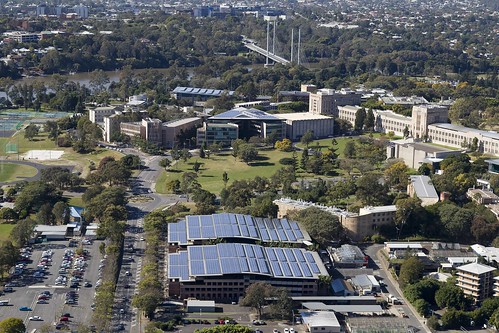
The array can generate 1.22 megawatts at peak production and is expected to supply 5-6% of the peak power demand of UQ. With a peak demand of ~25Mw UQ is a big energy user so it is good that it's electricity just got a little greener. So good on UQ for building it and also to Prof Paul Meredith for all his work making it happen. No word on whether Paul enjoys being the new poster boy for the university as a consequence.
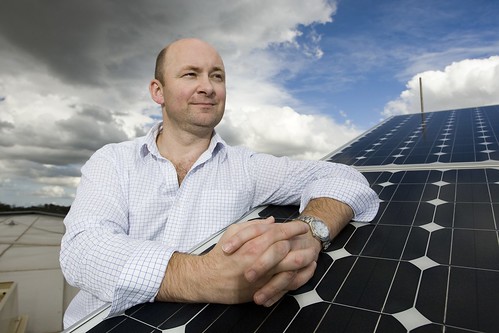
This system isn't just being used to provide electricity though, it's also a research tool for studying intermittent power sources, use of battery storage and panel shading analysis etc. The UQ solar energy website also has a live feed where you can view historical plus real time data about how much electricity the solar array is generating.
The fact that the array is the largest in the country also shows how far we have to go in getting significant amounts of solar PV onto the grid. The UQ solar array is 1.22 Mw, while the next largest is on the roof of the Adelaide show grounds and comes in a 1 Mw. A large coal fired power plant would often be ~1000Mw. Also due to different capacity factors a ~1000Mw coal plant may well generate the same amount of power at ~2000Mw (or more) of solar PV.
Obviously one of the advantages of solar PV is its modular nature in that you don't need to make your power plants 1000Mw. But of course size does help with economies of scale. According to UQ the cost of the panels + installation was around $4 for every watt of generation capacity. Obviously this is more expensive than the coal price for a large electricity user like UQ, but I think it will eventually pay for itself in lower electricity costs (UQ gives a saving on the website but it is not clear to me if this has been calculated from the domestic tariff or the actual UQ tariff). One thing that will make it break even much more quickly would be the introduction of a carbon price, one reason why pricing carbon will be a boon for renewable energy.
The array can generate 1.22 megawatts at peak production and is expected to supply 5-6% of the peak power demand of UQ. With a peak demand of ~25Mw UQ is a big energy user so it is good that it's electricity just got a little greener. So good on UQ for building it and also to Prof Paul Meredith for all his work making it happen. No word on whether Paul enjoys being the new poster boy for the university as a consequence.
This system isn't just being used to provide electricity though, it's also a research tool for studying intermittent power sources, use of battery storage and panel shading analysis etc. The UQ solar energy website also has a live feed where you can view historical plus real time data about how much electricity the solar array is generating.
The fact that the array is the largest in the country also shows how far we have to go in getting significant amounts of solar PV onto the grid. The UQ solar array is 1.22 Mw, while the next largest is on the roof of the Adelaide show grounds and comes in a 1 Mw. A large coal fired power plant would often be ~1000Mw. Also due to different capacity factors a ~1000Mw coal plant may well generate the same amount of power at ~2000Mw (or more) of solar PV.
Obviously one of the advantages of solar PV is its modular nature in that you don't need to make your power plants 1000Mw. But of course size does help with economies of scale. According to UQ the cost of the panels + installation was around $4 for every watt of generation capacity. Obviously this is more expensive than the coal price for a large electricity user like UQ, but I think it will eventually pay for itself in lower electricity costs (UQ gives a saving on the website but it is not clear to me if this has been calculated from the domestic tariff or the actual UQ tariff). One thing that will make it break even much more quickly would be the introduction of a carbon price, one reason why pricing carbon will be a boon for renewable energy.
Sunday, August 21, 2011
Carbon price package presentation from TTKD August meeting now available online
There were some requests for a copy of the talk given by Mike Clark on the Government's proposed clean energy future/ carbon price plan at our most recent meeting.
A pdf copy of the talk can now be found on Scribd and is embedded below. The pdf version is without some rather extensive notes contained in the power point to help explain each slide. The powerpoint is also available on Scribd.
Carbon Price Package
Nb: The presentation also contains some extra slides (30-34) not shown in the talk
A pdf copy of the talk can now be found on Scribd and is embedded below. The pdf version is without some rather extensive notes contained in the power point to help explain each slide. The powerpoint is also available on Scribd.
Carbon Price Package
Nb: The presentation also contains some extra slides (30-34) not shown in the talk
Monday, August 15, 2011
TTKD August meeting: The Carbon Tax/ Clean Energy Future Package
- Confused about the carbon price package?
- Concerned about the cost?
- Keen on clean energy?
- Got questions?
You are not alone. Come along to the Transition Town Kenmore August meeting where we will dissect the Clean Energy Future package.
Mike Clark, our local policy enthusiast, will be presenting the details of the package, followed by Q&A and general discussion.
We hope to see you all there.
- Concerned about the cost?
- Keen on clean energy?
- Got questions?
You are not alone. Come along to the Transition Town Kenmore August meeting where we will dissect the Clean Energy Future package.
Mike Clark, our local policy enthusiast, will be presenting the details of the package, followed by Q&A and general discussion.
We hope to see you all there.
Thursday 18 August,
from 7.30pm
Kenmore Library Meeting Room
from 7.30pm
Kenmore Library Meeting Room
Wednesday, August 3, 2011
The government's carbon price mailout
I've just finished reading the Gillard governments' carbon price mailout which arrived yesterday.
It reinforces in my mind, how, by creating a comprehensive policy, they have also created quite a complex policy. Although the household compensation is only one aspect of the package it takes up the vast majority of the handout. (For anyone reading who wants to know how you and your family will be affected the best way to check is this online calculator). As far as I can tell everything in the mailout is more or less correct and I thought the section "How will a carbon price cut pollution?" was quite good with some pertinent points:
The mailout does spend a bit of time talking about one aspect of the package that I like, which is the increase in the tax free threshold from $6000/year to over $18 000/year. I have seen some commentators criticize the package for including things like this, saying it makes it too complex and distracts from the main message. On the other hand, since the package needed to include household compensation anyway, why not utilise the chance to introduce a tax change recommended by the Henry review and which the economic boffins think is a good idea.
Conversely the mailout spends very little time talking about the $10 billion dollars for clean energy in the carbon package. $10 billion dollars is a serious chunk of change and should be a big shot in the arm to the industry. Hopefully this policy has got into the general consciousness of the public despite all the other parts of the package competing for airtime.
Lastly, it is always going to be somewhat controversial when a government carries out public education campaigns. I can understand why some would rather the government not spend any taxpayer money on such things. On the other hand, this is a large and complex policy with important implications for the country. A loud, well funded and often misleading campaign has and is being run against it. In such a case do people not deserve to be given the facts lest they form their opinions based on incorrect or misleading information? In this the mailout does ok but isn't perfect, while it is clear from reading it that not everyone is fully compensated, perhaps unsurprising there are no profiles on a family from the minority of Australian's (generally the wealthy) who won't be fully compensated. Guess that's PR for you.
It reinforces in my mind, how, by creating a comprehensive policy, they have also created quite a complex policy. Although the household compensation is only one aspect of the package it takes up the vast majority of the handout. (For anyone reading who wants to know how you and your family will be affected the best way to check is this online calculator). As far as I can tell everything in the mailout is more or less correct and I thought the section "How will a carbon price cut pollution?" was quite good with some pertinent points:
"Currently, releasing carbon pollution is free despite the fact that it is harming Australia's environmentI think this is quite a good way to explain in a nutshell how and why a carbon price will be effective. It seems the govt has decided to back off talking about how carbon pricing will change consumer behaviour at the household level (although it will to some extent) and focus on where most of the action is, which is investment decisions by large companies, especially the large polluters.
A carbon price changes this. It puts a price on the carbon pollution that Australia's largest polluters produce. This creates a powerful incentive for businesses to cut their pollution, by investing in clean energy or finding more efficient ways of operating"
The mailout does spend a bit of time talking about one aspect of the package that I like, which is the increase in the tax free threshold from $6000/year to over $18 000/year. I have seen some commentators criticize the package for including things like this, saying it makes it too complex and distracts from the main message. On the other hand, since the package needed to include household compensation anyway, why not utilise the chance to introduce a tax change recommended by the Henry review and which the economic boffins think is a good idea.
Conversely the mailout spends very little time talking about the $10 billion dollars for clean energy in the carbon package. $10 billion dollars is a serious chunk of change and should be a big shot in the arm to the industry. Hopefully this policy has got into the general consciousness of the public despite all the other parts of the package competing for airtime.
Lastly, it is always going to be somewhat controversial when a government carries out public education campaigns. I can understand why some would rather the government not spend any taxpayer money on such things. On the other hand, this is a large and complex policy with important implications for the country. A loud, well funded and often misleading campaign has and is being run against it. In such a case do people not deserve to be given the facts lest they form their opinions based on incorrect or misleading information? In this the mailout does ok but isn't perfect, while it is clear from reading it that not everyone is fully compensated, perhaps unsurprising there are no profiles on a family from the minority of Australian's (generally the wealthy) who won't be fully compensated. Guess that's PR for you.
Saturday, July 30, 2011
Unravelling a few of Australia's climate change myths
Australia has recently been host to a fairly prominent visitor from the UK, no not that one, I mean Sir Richard Lambert. Until recently Lambert was Director-General of the Confederation of British Industry, the UK's top business and industry organisation. So it's fair to assume he has a good knowledge of how business is affected by and responds to carbon pricing like they have in Europe.
Lambert has clearly been quite surprised by the nature of the climate change "debate" in Australia and has contributed a post to ABC The Drum "Unravelling a few of Australia's climate change myths". Worth a read. See him also on Lateline business.
Lambert has clearly been quite surprised by the nature of the climate change "debate" in Australia and has contributed a post to ABC The Drum "Unravelling a few of Australia's climate change myths". Worth a read. See him also on Lateline business.
Friday, July 15, 2011
10 things to know about the carbon price
We now know the details of the governments package to tackle climate change by pricing carbon pollution. My live blog about the carbon price was a bit messy. So I've cleaned it up a bit.
Here are the 10 important points:
1. A price on pollution of $23 a ton
2. Pollution cuts of at least 5% by 2020 and 80% by 2050
3. Scheme starts as a "tax" but moves to an emissions trading scheme in 2015
4. 500 biggest polluters will pay for their carbon pollution
5. Price rises will be modest - expected to raise average prices by 0.7%
6. Compensation for households will see most better or no worse off
7. Tackling climate change now is cheaper and easier than waiting or doing nothing
8. Over 10 billion dollars for renewable energy
9. Money for storing carbon in land, improving biodiversity, closing down the dirtiest coal plants and helping industry be more efficient.
10. Vulnerable industries who are trade exposed get generous assistance
For more detail on each point see this post.
Here are the 10 important points:
1. A price on pollution of $23 a ton
2. Pollution cuts of at least 5% by 2020 and 80% by 2050
3. Scheme starts as a "tax" but moves to an emissions trading scheme in 2015
4. 500 biggest polluters will pay for their carbon pollution
5. Price rises will be modest - expected to raise average prices by 0.7%
6. Compensation for households will see most better or no worse off
7. Tackling climate change now is cheaper and easier than waiting or doing nothing
8. Over 10 billion dollars for renewable energy
9. Money for storing carbon in land, improving biodiversity, closing down the dirtiest coal plants and helping industry be more efficient.
10. Vulnerable industries who are trade exposed get generous assistance
For more detail on each point see this post.
Thursday, July 14, 2011
TTKD July Meeting - Responsible and Ethical financial management + a quick carbon price chat
Steve Putt is the Managing Director of Viridian Wealth Management Pty Ltd, a financial planning firm that specialises in strategic advice, and responsible investment.
Steve has 15 years experience in the financial services industry. He has a passion for sustainability, and believes that not only should be people be aware of what their money is up to, but that they can drive social change by marrying their personal beliefs with ethical wealth creation strategies.
His talk to Transition Towns Kenmore will cover his background, how Viridian Wealth Management Pty Ltd came to be, and some tips on finding out what you can do. Steve believes that most people are unaware of the companies they support with passive investment decisions, specifically through their superannuation.
He believes it is an important message to hear that people have choices in how they invest, which can drive social and environmental change.
After Steve has spoken and we have had a Q&A about ethical / sustainable investing, if people want we can also discuss the carbon price package.
Steve has 15 years experience in the financial services industry. He has a passion for sustainability, and believes that not only should be people be aware of what their money is up to, but that they can drive social change by marrying their personal beliefs with ethical wealth creation strategies.
His talk to Transition Towns Kenmore will cover his background, how Viridian Wealth Management Pty Ltd came to be, and some tips on finding out what you can do. Steve believes that most people are unaware of the companies they support with passive investment decisions, specifically through their superannuation.
He believes it is an important message to hear that people have choices in how they invest, which can drive social and environmental change.
After Steve has spoken and we have had a Q&A about ethical / sustainable investing, if people want we can also discuss the carbon price package.
When: Thursday 21 July, 2011. 7.30pm
Where: Kenmore Library
Where: Kenmore Library
NOTE: New day! Meetings now on Thursdays
Wednesday, July 13, 2011
Some journalistic takes on the carbon price
Couple of interesting pieces in the SMH today regarding the carbon price/tax
Ross Gittins: Give and take: this new tax is a piece of cake
Explaining how a carbon price can work even though people are being compensated.
Lenore Taylor: Facts assail Abbott's Chicken Little act
Fact checking Abbott's arguments against the carbon tax.
Ross Gittins: Give and take: this new tax is a piece of cake
Explaining how a carbon price can work even though people are being compensated.
Lenore Taylor: Facts assail Abbott's Chicken Little act
Fact checking Abbott's arguments against the carbon tax.
Subscribe to:
Posts (Atom)