Thursday, May 5, 2011

Electric cars - An important solution in a world of peak oil.

Last week ABC Catalyst looked at peak oil and how high petrol prices are here to stay. An obvious response to these issues is to make the economy (and the people within it) less dependent on oil by using less of it. This week Catalyst went to America to preview one of the core solutions to this problem - electric cars.

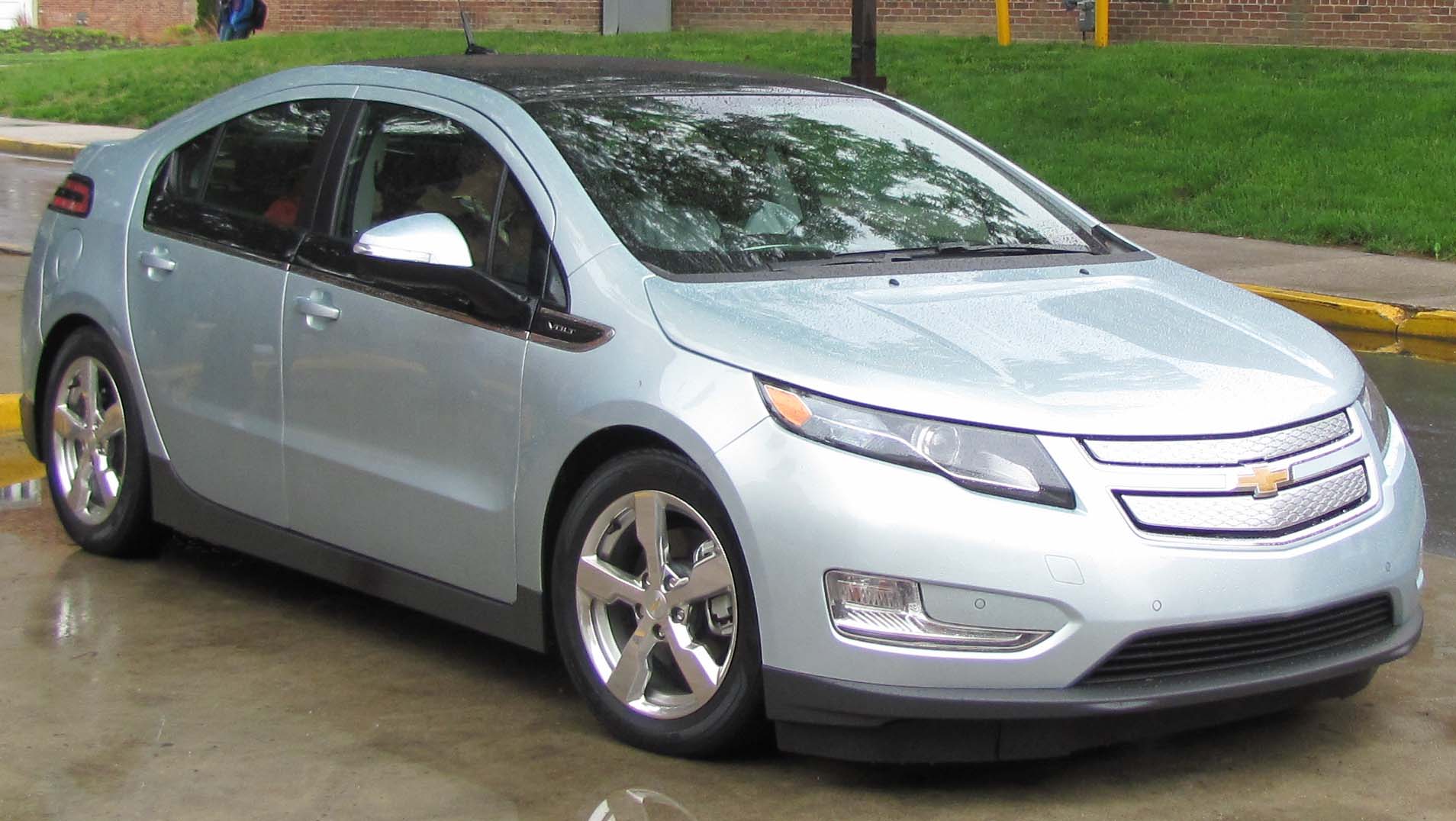
Electric cars have come along way in the past decade or so and two currently on sale in the USA are the Chevy (Holden) - Volt and the Nissan -Leaf. There has been a lot of buzz about these cars, and both have won several "Car of the year awards".

There are a lot of advantages to electric cars, beyond just reducing oil use. Electric motors are much more efficient than petrol engines, so this and the high price of oil make electric cars much cheaper to drive per km. With no tail pipe emissions electric cars help to clean up polluted city air and of course emit no greenhouse gasses. In fact if your electricity comes from renewable sources then they truely are zero emissions vehicles.

So how do they work?

Well the Volt is a plug in hybrid electric vehicle (PHEV). It has a battery which powers an electric motor. In electric only driving it can travel ~55 km on a single charge. Then as the battery gets depleted a small petrol engine starts up which powers an electric generator to keep the car going and give it a total range of ~600km. In this way the Volt eliminates "range anxiety", the fear you'll run out of battery charge and be stuck somewhere. But here's the clever bit, most people drive less than 55km in their daily commute, which means you can charge the battery between commuting and continually run in all-electric mode. Then if you want to drive long distance on the weekend, you still can. The volt plans to be, and is, a replacement for the main family car. Another benefit is the battery can be charged from a normal residential power point, making this process nice and easy.


The LEAF (unlike the Volt) is a pure electric vehicle (PEV), it has no petrol engine at all, instead it has a lot of batteries and an electric engine. Since it is all electric it's battery range is longer than the Volt at ~110 km. Only having one engine (and not being a hybrid) also makes the Leaf cheaper than the Volt. The leaf is ideal for shorter trips or commuting but although the batteries can be high voltage fast charged in ~30minutes it isn't ideal for long trips.

Photo: Tennen-Gas. Permission: cc-by-sa-3.0

Both these cars should be hitting our shores in 2012.

For even more info about these cars, see the wikipedia pages on the Volt and the Leaf

Monday, May 2, 2011

The Oil Crunch - Peak oil on a special edition of Catalyst

The age of cheap, plentiful, oil is over. That's the unmistakable conclusion from last weeks ABC Catalyst program - The Oil Crunch. If you missed it, you can view the program and extended interviews here.

Catalyst went and interviewed the chief economist at the International Energy Agency (IEA), an organisation that advises many countries, including Australia, and which is about as mainstream as you can get on energy issues.

The news was "not very bright". According to Dr Fatih Birol, the IEA's chief economist, world crude oil production peaked in 2006 and;
"Existing fields are declining sharply..... just to stay where we are today, we have to find four new Saudi Arabia's". That is a tall order."

So to underline this point, the IEA now says peak oil (of crude) was likely in 2006. Peak oil doesn't mean that there is no oil left, or even that we have used most of it, just that the amount we can pump every day is in decline.

So what are their projections for the future? Well in the past the IEA were projecting the world could pump 120 million barrels of oil per day by 2030, compared to the ~88 million it pumps today. Nowadays, even under an optimist projection, oil production will only increase to 96 million barrels of oil a day in 2035. There are three important points to be made about this.

1) The only reason oil production can increase in total is due to "unconventional" oil. However much of this is oil made from coal, or extracted from Canadian tars sands. This oil has much higher greenhouse gas emissions that conventional oil and from a global warming perspective is a terrible idea.

2) Some groups such as the Association for the Study of Peak Oil and Gas (ASPO) believe that even these new IEA figures are far to optimistic. They believe that the decline in pumped crude will be much faster, because we simply don't have the ability to bring new oil fields online fast enough to replace the declining existing ones, something that Dr Birol admits is possible. (Prof Kjell Aleklett President of ASPO is also interviewed by Catalyst).

3) Supply and demand.
Under optimistic IEA projections oil supply (by including all sources no matter how polluting) can only increase slightly to 96 million barrels per day in 2035, but oil demand is increasing rapidly, especially in Asia. Both the IEA in their World Energy Outlook and the US Govts' Energy Information Agency (EIA) 2010 Energy Outlook predict demand above this level of supply, with the EIA projecting consumption of liquid fuels to be "110.6 million barrels per day in 2035".

This simply won't work, either the world will have to find huge amounts of extra oil (biofuels?), or there won't be enough oil to meet demand, which will mean high prices and economic disruption. This is the real issue of peak oil, not that oil does peak, but that when it does world demand will still be rising and supply won't be able to keep up. We are left in my opinion with a new economic TINA, reduce our dependence on oil.

As for solutions, well they are out there, this post is long enough already but for a start you might want to check out the next edition of Catalyst where they will be checking out electric cars. While this SMH article foreshadows the forthcoming Beyond Zero Emissions report on a sustainable transport system to follow up their zero carbon power generation plan.

Friday, April 15, 2011

TTKD April meeting: Screening "David Suzuki - Force of Nature". (Note venue change)

Next Wednesday 20 April at 7.30pm we have our monthly meeting where we will be showing David Suzuki's new film Force of Nature.

"David Suzuki, iconic Canadian scientist, educator, broadcaster and activist delivers a 'last lecture' — what he describes as "a distillation of my life and thoughts, my legacy, what I want to say before I die."The film interweaves the lecture with scenes from the places and events in Suzuki's life — creating a biography of ideas — forged by the major social, scientific and cultural events of the past 70 years."

You can view the trailer here. We have been lucky enough to get a free screening of this movie through Curious Films however they would like a donation of $2.50 per person to a charity. We have nominated the Cubberla-Witton Catchment Network.

Please note the new venue - the new Kenmore Library at the Kenmore village shopping centre, details below:

We have decided to trial a new meeting venue - at the new Kenmore Library (near the Post Office entrance to the Kenmore Village Shopping Centre), as they have a great room, and it’s free. It’s Meeting Room 3 on level 1. The library closes at 6pm and access after this time is via swipe card. We will only have one swipe card.

So please go to the After Hours Lift Entrance on the ground floor. It’s under the library, right by the car park, behind the library’s main escalator entrance. Someone will be there to take you up to the meeting room. It sounds a bit complicated I know but hopefully it will all be fine! If you arrive late (I'll keep someone at the door till about 7.45) please press the buzzer for Meeting Room 3, and someone will come and let you in.

Remember, I'd love to hear from anyone who is keen to be a member of the Transition Kenmore Steering Committee. If you'll be at the meeting on Wednesday we can talk then, if not send us a quick email to let me know you're interested.

If you don't want to be on the steering committee but have an idea for an event or upcoming meeting similarly have a chat to us about it at the meeting or send us an email and we can see what we can do.

Looking forward to seeing you there

7:30pm
Wed 20th April
Kenmore Library
Kenmore Village Shopping Centre

Sunday, April 10, 2011

The Brisbane climate action rally

Thanks to everyone who came to the Brisbane Climate Action Rally yesterday. There was a great turnout and a really positive atmosphere of people who want Australia to cut pollution and start moving to a clean energy economy.
There were some cool placards too, thanks to John Cook from Skeptical Science for capturing some of them.


Tuesday, April 5, 2011

Climate change doubters are endangering our common future


"Most of us do accept the science that human action is changing our climate directly and that only by cutting emissions dramatically can we avert real disaster. Even those who aren't sure take the view that simple prudence dictates action. After all, none of us thinks our homes will be burnt down, but we do take out fire insurance. In fact the probabilities on climate change are far, far higher and the consequences of inaction almost unthinkable".

No that's not Bob Brown, it's John Gummer a British Conservative Party politican who was a minister in the Thatcher and Major governments and is now a member of the House of Lords. Although it may seem surprising here in OZ, he, like many conservatives in Europe and the UK is also a strong supporter of action on climate change. His piece "Climate change doubters are endangering our common future" was published in The Australian a week or two ago and does a good job of helping to explain why action on climate change is necessary and why meaningful action has bipartisan support in the UK and Europe.

"The science is now even more compelling but even if it weren't, most of what we have to do to fight climate change we will have to do anyway. With the world population reaching 9 billion by 2050 and more and more of its people living above subsistence level, we just have to learn to conserve our resources and do more with less. There are now more middle-class people in India than there are in Europe. In China, internal demand for goods and services is escalating at an enormous rate. I returned from a visit to Beijing at the end of last month. The next five-year plan will put sustainability and the battle against climate change at the heart of the nation's economic policy."

"So it is not only the Europeans - Right and Left - who have taken up the challenge. From California to Korea, governments and civil society are finding their own ways to work towards a world that is not threatened by pollution. Even if they were all wrong and we acted, the result would be that we would have a cleaner planet, more able to cope with feeding, housing, and clothing those 9 billion people. If, however, we follow the sceptics and they turn out to be wrong, then we would leave our children a legacy of destruction. The risk is all one way, which explains why in Britain, scepticism is confined to the extremes."
The bolding is my emphasis because I think it sums things up pretty neatly.

Gummer finishes with a call for us here in Australia to play our part in combating climate change:

"In the end, we all have to face the facts. The scientific consensus is now so significant that, even if we ourselves remain doubters, it would be wrong to endanger our children by hoping for the best. If we act sensibly there is real chance of success. The rest of the world is doing it, and I hope that Australia will join us in her own way and play her part in protecting our common future."


As the pollies say: Hear hear!

Sunday, April 3, 2011

Carbon pricing and the cost of electricity


"The electricity sector will respond strongly to reduce emissions with carbon pricing"
Prof Ross Garnaut has been releasing a series of updates to his 2008 review. The latest is an investigation in the electricity sector and how it will be affected by carbon pricing. You can read a summary or the whole update here.

In summary:
The good news, as quoted above, is that carbon pricing will be effective in reducing emissions from the electricity sector. Old electricity plants need to be replaced with new ones all the time and because a carbon price will make polluting plants more costly, less polluting/ clean energy plants will be built instead. This is how carbon pricing will reduce emissions by changing investment decisions, even if the users of electricity were to make no behavioural changes themselves.
"The introduction of a carbon price is highly unlikely to threaten physical energy security"
ie: the light will stay on. Also good news.

"While electricity prices will rise in coming years, the increase associated with a carbon price is in fact smaller than recent increases"
Electricity prices have been rising in recent years mainly because, (as Garnaut points out), of the increased costs of electricity distribution and transmission, not generation. Carbon pricing will increase generation costs but this will actually be quite modest compared to the cost rises currently being experienced. Also it is these increased generation costs that households will be compensated for. Furthermore, Garnaut reports that poor and inefficient regulation of the electricity sector has exacerbated recent rises in electricity prices and that better regulation could greatly decrease future cost increases. If this turns out to be the case then we have the opportunity to clean up the electricity sector and keep price rises to a minimum.

Rally for Climate Action: Brisbane April 9th

"Next Saturday it’s time for Queenslanders to let our politicians know that we support Queensland and Australia’s clean energy future - and the many new jobs and business opportunities it will create.

On Saturday 9th at 11am we're uniting with our friends from the Australian Youth Climate Coalition , GetUp! , Greenpeace , Oxfam , Australian Conservation Foundation , World Wildlife Fund and Union Climate Connectors to support real action against climate change.

It's time to make the big polluters pay their fair share and unlock Australia's clean energy future. By acting now we can stay healthy, secure our environment, protect jobs and build new clean industries.

This is a family friendly gathering where we’ll hear speakers who understand the science and we’ll celebrate our positive message for change in Australia.

So come along on Saturday the 9th at 11am in King George Square, bring some mates and take a stand in support of fair and effective action on climate change."


Rally for Climate Action
April 9, 11am
King George Sq
Brisbane City

Downloadable poster can be found here
If you are on Facebook you can RSVP here.

Getting there:
Being in the centre of the city, King George Sq is easy to get to.
By Train: Head to Central Station
By Bus: Go to King George Square Busway, or just a short walk from Queen St Busway