The carbon farming initiative (CFI), which allows farmers and land managers to earn credits by reducing pollution and sequestering carbon in trees and the soil has passed the parliment and is set to become law.
The basic idea here is that carbon credits can be earned for various practices that either reduce emissions from the land sector or sequester carbon dioxide. These credits can then be sold as offsets to polluters both in Australia and overseas. In this way farmers etc can earn money from better land management practices and reforestation etc. Overall carbon farming is only a small part of the carbon price package and will only equate to a small amount of the greenhouse gas reductions between now and 2020. However it does provide an incentive to use the land more sustainably and turn the land into carbon sinks.
One of the questions about carbon farming is its ability to reduce emissions or sequester carbon in the long term. Ie: If you sequester carbon by planting trees and then these trees die in a drought. Clearly verification of actual emission reductions followed by long term monitoring is going to be necessary. Despite these challenges, carbon farming does have potential and seeking to tap this potential is a worthwhile endeavor.
Nb: For those interested in comparing the climate change policies of Labour and the LNP.
While carbon farming is a minor part of the governments carbon reduction plans, the LNP hopes it will provide the majority of greenhouse gas reductions under their proposed policy. However, although the LNP say they support the CFI it in principle, they voted against it. Politics eh?
Friday, August 26, 2011


Wednesday, August 24, 2011
Have your say on public transport in the Western Suburbs
If you have any suggestions or comments regarding public transport in the Western Suburbs (and I know many of you do!), here is your chance to be heard.
Wilson Lowe is receiving email feedback from people in the Western Suburbs regarding any suggestions or comments about public transport in the area. He will collate all of the feedback and take it to the next Public Transport Advisory Group Meeting. His email address is lowe.wilson@gmail.com.
More information regarding the Public Transport Advisory Group can be found here: http://translink.com.au/about-translink/reporting-and-publications/media-releases/release/325
Wilson Lowe is receiving email feedback from people in the Western Suburbs regarding any suggestions or comments about public transport in the area. He will collate all of the feedback and take it to the next Public Transport Advisory Group Meeting. His email address is lowe.wilson@gmail.com.
More information regarding the Public Transport Advisory Group can be found here: http://translink.com.au/about-translink/reporting-and-publications/media-releases/release/325
Native Bee Workshop
NATIVE BEE WORKSHOP
with entomologist and stingless bee keeper, Dr. Tim Heard, CSIRO.
When: Saturday October 29 9.30 a.m. - 3.30 pm
Where: The Hut (47 Fleming Road Chapel Hill 4069)
As well as explaining the natural history of our native stingless bee, Trigona carbonaria, Tim will demonstrate keeping a colony, and you will have the chance to taste the honey.
If you have a colony in a hollow log that you would like to transfer into a box, Tim may be able to do it for you at the workshop. Please let us know beforehand.
Morning tea and lunch will be provided.
Bookings are essential. Please contact Pam Jones (Secretary) at pam.jones10@bigpond.com.au or ring mobile 0419648154.
Cost: $25 ($20 for THECA members).
You can send your form to THECA, P.O. Box 804, Kenmore, 4069.
PLEASE BOOK EARLY.
with entomologist and stingless bee keeper, Dr. Tim Heard, CSIRO.
When: Saturday October 29 9.30 a.m. - 3.30 pm
Where: The Hut (47 Fleming Road Chapel Hill 4069)
As well as explaining the natural history of our native stingless bee, Trigona carbonaria, Tim will demonstrate keeping a colony, and you will have the chance to taste the honey.
If you have a colony in a hollow log that you would like to transfer into a box, Tim may be able to do it for you at the workshop. Please let us know beforehand.
Morning tea and lunch will be provided.
Bookings are essential. Please contact Pam Jones (Secretary) at pam.jones10@bigpond.com.au or ring mobile 0419648154.
Cost: $25 ($20 for THECA members).
You can send your form to THECA, P.O. Box 804, Kenmore, 4069.
PLEASE BOOK EARLY.
Tuesday, August 23, 2011
The University of Queensland Solar Array
As hopefully many of you are aware, a couple of months back the largest flat-panel solar PV system in Australia was opened at the University of Queensland. With just over 5000 solar panels spread across the rooftops of 4 buildings it's an impressive sight.
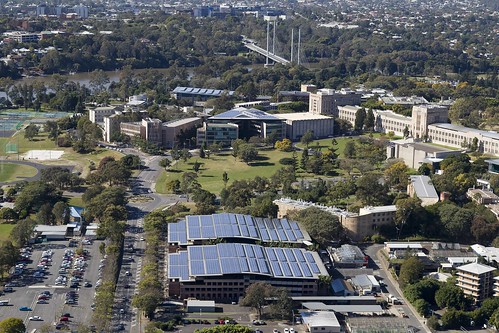
The array can generate 1.22 megawatts at peak production and is expected to supply 5-6% of the peak power demand of UQ. With a peak demand of ~25Mw UQ is a big energy user so it is good that it's electricity just got a little greener. So good on UQ for building it and also to Prof Paul Meredith for all his work making it happen. No word on whether Paul enjoys being the new poster boy for the university as a consequence.
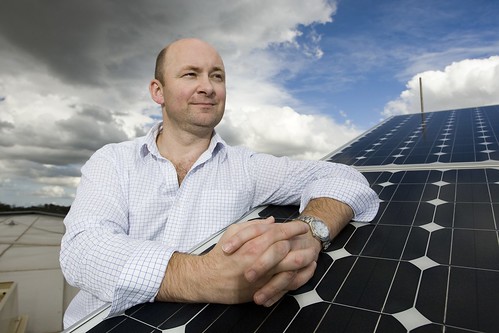
This system isn't just being used to provide electricity though, it's also a research tool for studying intermittent power sources, use of battery storage and panel shading analysis etc. The UQ solar energy website also has a live feed where you can view historical plus real time data about how much electricity the solar array is generating.
The fact that the array is the largest in the country also shows how far we have to go in getting significant amounts of solar PV onto the grid. The UQ solar array is 1.22 Mw, while the next largest is on the roof of the Adelaide show grounds and comes in a 1 Mw. A large coal fired power plant would often be ~1000Mw. Also due to different capacity factors a ~1000Mw coal plant may well generate the same amount of power at ~2000Mw (or more) of solar PV.
Obviously one of the advantages of solar PV is its modular nature in that you don't need to make your power plants 1000Mw. But of course size does help with economies of scale. According to UQ the cost of the panels + installation was around $4 for every watt of generation capacity. Obviously this is more expensive than the coal price for a large electricity user like UQ, but I think it will eventually pay for itself in lower electricity costs (UQ gives a saving on the website but it is not clear to me if this has been calculated from the domestic tariff or the actual UQ tariff). One thing that will make it break even much more quickly would be the introduction of a carbon price, one reason why pricing carbon will be a boon for renewable energy.
The array can generate 1.22 megawatts at peak production and is expected to supply 5-6% of the peak power demand of UQ. With a peak demand of ~25Mw UQ is a big energy user so it is good that it's electricity just got a little greener. So good on UQ for building it and also to Prof Paul Meredith for all his work making it happen. No word on whether Paul enjoys being the new poster boy for the university as a consequence.
This system isn't just being used to provide electricity though, it's also a research tool for studying intermittent power sources, use of battery storage and panel shading analysis etc. The UQ solar energy website also has a live feed where you can view historical plus real time data about how much electricity the solar array is generating.
The fact that the array is the largest in the country also shows how far we have to go in getting significant amounts of solar PV onto the grid. The UQ solar array is 1.22 Mw, while the next largest is on the roof of the Adelaide show grounds and comes in a 1 Mw. A large coal fired power plant would often be ~1000Mw. Also due to different capacity factors a ~1000Mw coal plant may well generate the same amount of power at ~2000Mw (or more) of solar PV.
Obviously one of the advantages of solar PV is its modular nature in that you don't need to make your power plants 1000Mw. But of course size does help with economies of scale. According to UQ the cost of the panels + installation was around $4 for every watt of generation capacity. Obviously this is more expensive than the coal price for a large electricity user like UQ, but I think it will eventually pay for itself in lower electricity costs (UQ gives a saving on the website but it is not clear to me if this has been calculated from the domestic tariff or the actual UQ tariff). One thing that will make it break even much more quickly would be the introduction of a carbon price, one reason why pricing carbon will be a boon for renewable energy.
Sunday, August 21, 2011
Carbon price package presentation from TTKD August meeting now available online
There were some requests for a copy of the talk given by Mike Clark on the Government's proposed clean energy future/ carbon price plan at our most recent meeting.
A pdf copy of the talk can now be found on Scribd and is embedded below. The pdf version is without some rather extensive notes contained in the power point to help explain each slide. The powerpoint is also available on Scribd.
Carbon Price Package
Nb: The presentation also contains some extra slides (30-34) not shown in the talk
A pdf copy of the talk can now be found on Scribd and is embedded below. The pdf version is without some rather extensive notes contained in the power point to help explain each slide. The powerpoint is also available on Scribd.
Carbon Price Package
Nb: The presentation also contains some extra slides (30-34) not shown in the talk
Monday, August 15, 2011
TTKD August meeting: The Carbon Tax/ Clean Energy Future Package
- Confused about the carbon price package?
- Concerned about the cost?
- Keen on clean energy?
- Got questions?
You are not alone. Come along to the Transition Town Kenmore August meeting where we will dissect the Clean Energy Future package.
Mike Clark, our local policy enthusiast, will be presenting the details of the package, followed by Q&A and general discussion.
We hope to see you all there.
- Concerned about the cost?
- Keen on clean energy?
- Got questions?
You are not alone. Come along to the Transition Town Kenmore August meeting where we will dissect the Clean Energy Future package.
Mike Clark, our local policy enthusiast, will be presenting the details of the package, followed by Q&A and general discussion.
We hope to see you all there.
Thursday 18 August,
from 7.30pm
Kenmore Library Meeting Room
from 7.30pm
Kenmore Library Meeting Room
Tuesday, August 9, 2011
Room for optomism - climate action in China
The rising emissions of carbon dioxide in China is one of the favourite excuses of those who would rather not act on climate change for not doing so. However, a look at what is actually happening in China and their future plans makes it clear they are taking climate change very seriously.
Obviously compared to Australia, China is in a different position with a rapidly developing economy and rising standards of living pushing hundreds of millions of people out of poverty and into the middle class.
Announcements in the last week or so have shown that China plans to:
- Introduce a feed-in tariff for solar power, which is likely to spur massive growth in solar PV generation.
- Set a cap on total energy use, which will help them in their plans to:
1) Improve energy efficiency
2) Set up a number of regional greenhouse gas emissions trading schemes.
3) Track of progress of indiviual provinces towards their emissions goals
4) Integrate regulatory policies such a greener building codes into a national policy.
China's overall goal is to decrease the "carbon intensity" of their economy by 40-45% by 2020. By carbon intensity they mean that a unit of economic active will produce ~40% less carbon emissions that it previously did. Even with these improvements China's emissions are going to continue to rise for the time being (however without serious action so will ours in Australia). What these actions aim to do is slow the emissions increases in China and stabilise them as quickly as possible, at which point they will likely still be considerably lower per person than here in Oz.
These actions in China, while helping them to continue to dominate the clean energy race, will also help to put them on a path to stabilising their carbon emissions. However, nothing promotes progress like progress and we in Australia, as one of the worlds top 20 largest economies and top 20 largest C02 emitters, have a responsibility to play our part by cutting our own emissions and then pushing China to do even more.
Obviously compared to Australia, China is in a different position with a rapidly developing economy and rising standards of living pushing hundreds of millions of people out of poverty and into the middle class.
Announcements in the last week or so have shown that China plans to:
- Introduce a feed-in tariff for solar power, which is likely to spur massive growth in solar PV generation.
- Set a cap on total energy use, which will help them in their plans to:
1) Improve energy efficiency
2) Set up a number of regional greenhouse gas emissions trading schemes.
3) Track of progress of indiviual provinces towards their emissions goals
4) Integrate regulatory policies such a greener building codes into a national policy.
China's overall goal is to decrease the "carbon intensity" of their economy by 40-45% by 2020. By carbon intensity they mean that a unit of economic active will produce ~40% less carbon emissions that it previously did. Even with these improvements China's emissions are going to continue to rise for the time being (however without serious action so will ours in Australia). What these actions aim to do is slow the emissions increases in China and stabilise them as quickly as possible, at which point they will likely still be considerably lower per person than here in Oz.
These actions in China, while helping them to continue to dominate the clean energy race, will also help to put them on a path to stabilising their carbon emissions. However, nothing promotes progress like progress and we in Australia, as one of the worlds top 20 largest economies and top 20 largest C02 emitters, have a responsibility to play our part by cutting our own emissions and then pushing China to do even more.
Subscribe to:
Comments (Atom)